


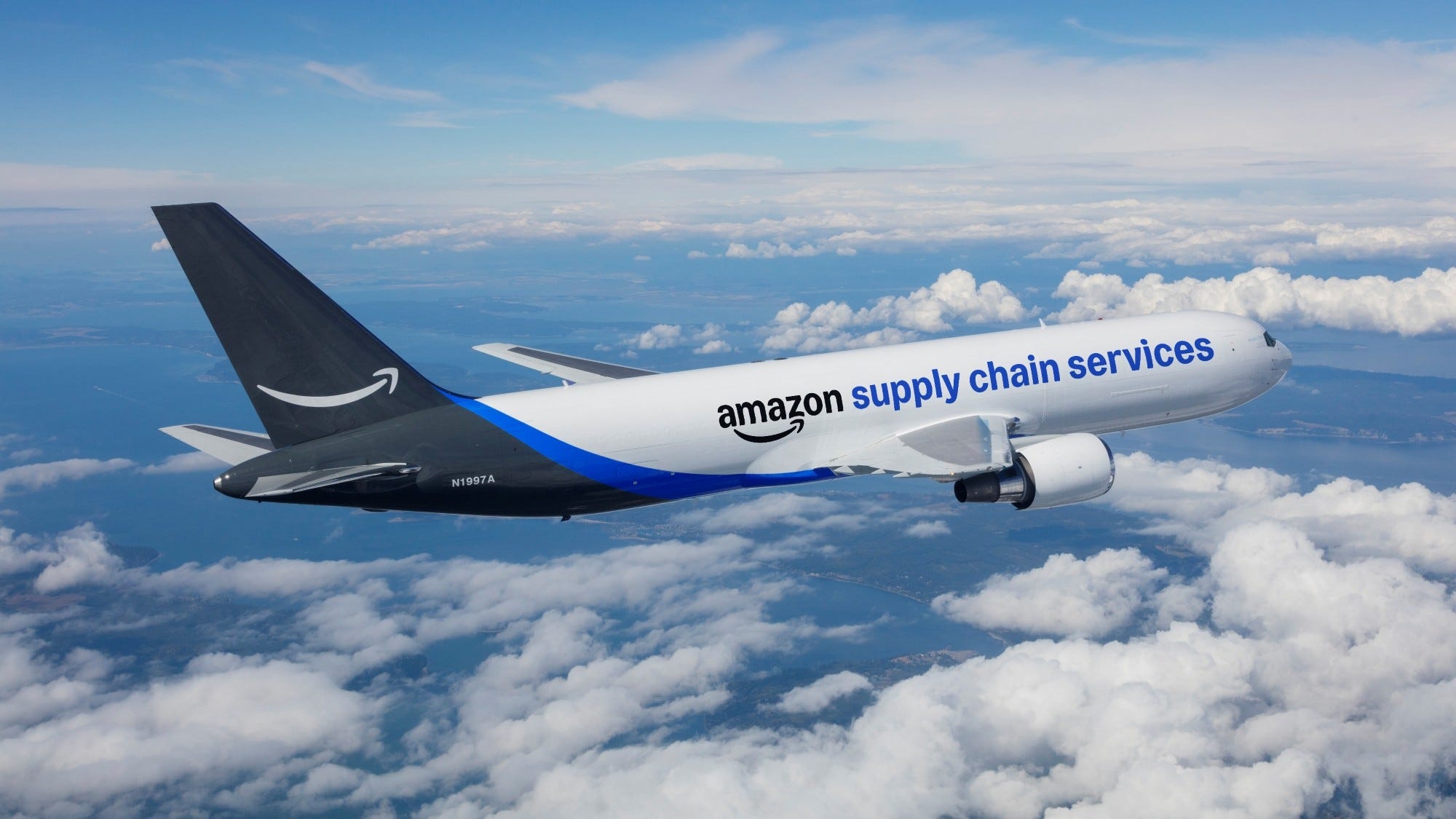
Amazon Supply Chain Services (ASCS) is more than a product launch; it marks a pivotal shift for companies in freight, logistics, and third-party logistics (3PL).
On May 4, 2026, Amazon opened its full supply chain network—including freight, distribution, fulfillment, and parcel delivery—to businesses of all sizes and industries, regardless of whether they sell on Amazon. This move shifted Amazon from the largest transportation customer to a direct competitor of UPS, FedEx, air cargo carriers, truckload carriers, and 3PLs.
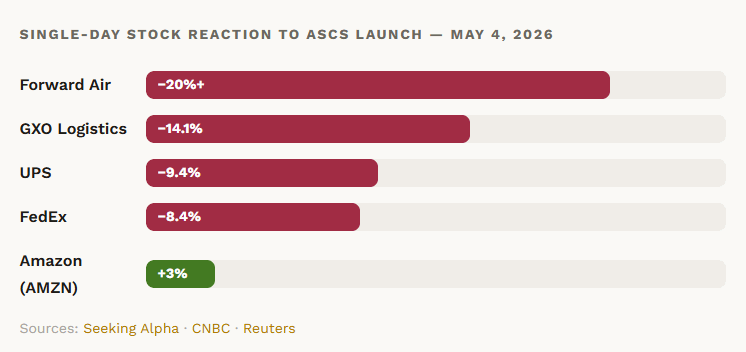
Wall Street reacted immediately. UPS and FedEx shares fell about 9–10% on the announcement day, while companies like Forward Air and GXO experienced double-digit declines. In contrast, Amazon’s stock reached a record high as investors recognized what many call the “AWS of logistics” moment.
This development signals a fundamental change in the industry, not just a promotional effort.
Key Takeaways for Executives
Any business can now use Amazon for comprehensive truckload, intermodal, air, ocean, warehousing, and parcel services.
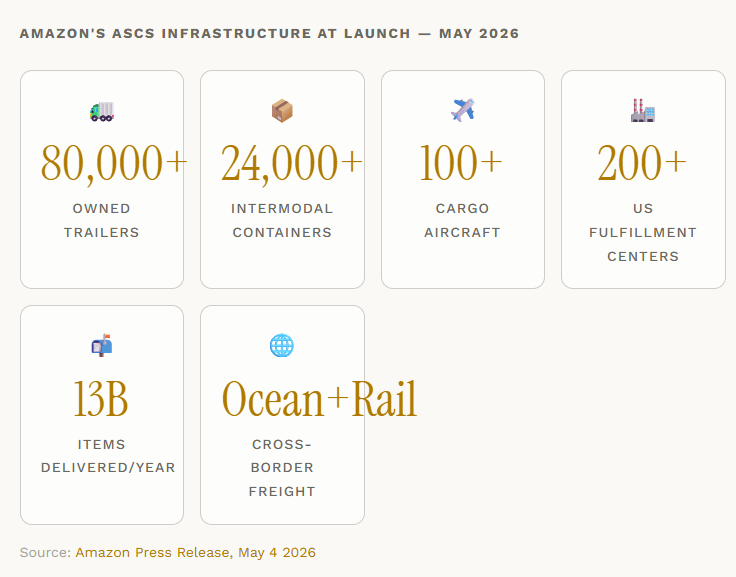
ASCS customers get access to Amazon’s own assets: more than 80,000 trailers, 24,000 intermodal containers, and 100 cargo aircraft, plus 200+ U.S. fulfillment nodes and seven-day parcel delivery.
Leading brands including Procter & Gamble, 3M, Lands’ End, and American Eagle were announced as early adopters on launch day.
Public markets immediately adjusted risk assessments across parcel, air freight, and logistics, with UPS and FedEx declining nearly 10% and Forward Air and GXO experiencing double-digit losses.
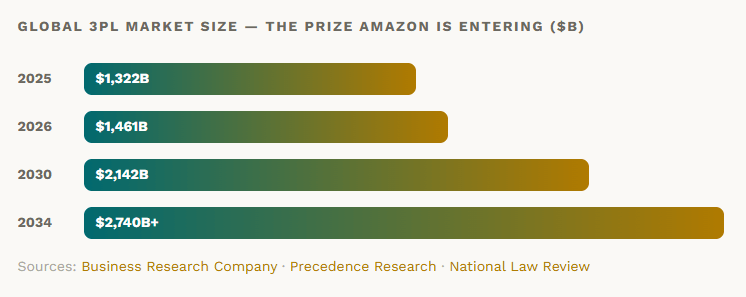
The opportunity is significant: the global 3PL market is valued at about $1.6 trillion in 2025 and is projected to reach $1.8 trillion in 2026, with annual growth of 5–10% depending on the segment.
In rail and intermodal, Amazon is becoming a major customer by controlling shipper relationships and containerized volume, rather than owning infrastructure.
What ASCS Actually Is (In Plain English)
ASCS converts the logistics infrastructure Amazon built for itself and its marketplace sellers into a service available to any business.
Amazon describes ASCS as opening its “full portfolio of freight, distribution, fulfillment, and parcel shipping capabilities to businesses of all types and sizes.” This now includes retail, healthcare, automotive, manufacturing, and other sectors beyond traditional e-commerce.
In practice, shippers can use Amazon to:
Move freight from the factory or port via ocean, air, truck, or intermodal.
Store inventory in regional nodes and forward-deploy closer to demand.
Fulfill orders across channels (DTC, wholesale, marketplaces).
Deliver parcels to the end customer, seven days a week, with Amazon-branded last-mile.
In summary, ASCS provides a comprehensive alternative to the existing mix of freight forwarders, 3PLs, carriers, and parcel integrators.
Amazon VP Peter Larsen stated in the launch release that businesses can now use “the same supply chain that supports Amazon.com” to move everything from raw materials to finished goods. This mirrors the strategy that turned idle server capacity into AWS.
The Market Reaction: A Real-Time Stress Test
In a single trading session after the announcement:
UPS fell more than 10%.
FedEx lost roughly 9%.
Forward Air and GXO Logistics dropped by double digits.
Bloomberg called it a “watershed” move for the parcel and logistics sector. CNBC highlighted that Amazon’s offering will “turn it into a major competitor for parcel carriers and air freight companies, and also impact truckers and third-party brokers.”
The market is not just reacting to a press release; it is reassessing incumbents’ future earnings as Amazon monetizes its network at scale.
The AWS Template: Internal Cost Center → External Platform
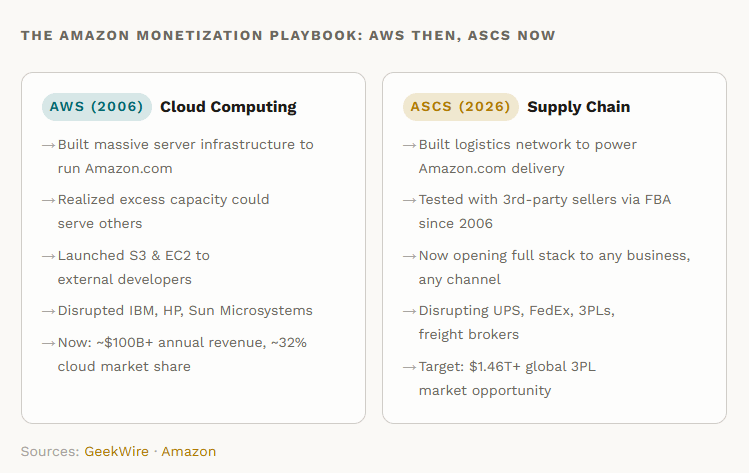
For investors and operators, the key takeaway is that Amazon is applying the AWS strategy to logistics.
AWS started as an internal infrastructure to run Amazon.com.
Amazon opened that infrastructure as a service to outsiders.
Incumbent technology vendors such as IBM, HP, and Sun were slow to recognize its significance, resulting in negative consequences.
With ASCS, Amazon is doing the same thing to logistics:
“Any business can now move, store, and deliver everything from raw materials to finished products quickly and reliably, using the same supply chain that supports Amazon.com.”
GeekWire framed it as turning Amazon’s logistics empire into a new business line that directly targets UPS and FedEx. TechCrunch highlighted that ASCS explicitly puts Amazon “head‑to‑head with the parcel incumbents” and 3PLs.
ASCS does not need to match AWS in scale to disrupt legacy players. It only needs to capture the highest value, most data-rich, and most scalable segments of the market.
Who’s Actually at Risk?
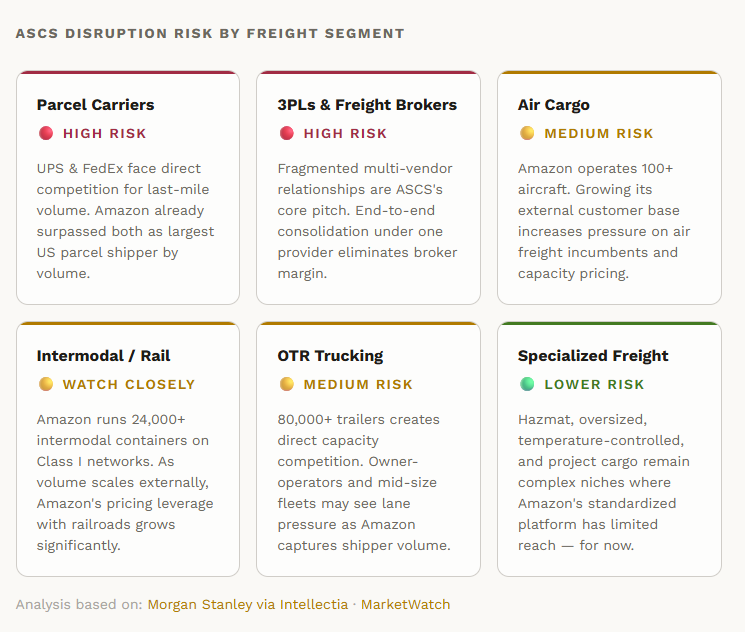
Various segments of the freight ecosystem face differing levels of exposure.
Parcel carriers (UPS, FedEx) – High risk
ASCS directly competes with their core business, including domestic and cross-border parcels, seven-day delivery, and premium time-sensitive services. Amazon already handles billions of parcels through its own network, and this capacity is now available to the market.
3PLs and freight brokers – High risk
ASCS’s value proposition is to “simplify your entire supply chain under one roof.” This directly competes with many 3PLs and brokers, especially mid-market firms lacking proprietary technology, data, or network density.
When Morgan Stanley warns that Amazon’s move will affect parcel, air freight, Rail, trucking, ocean, and warehousing all at once, that’s broker and 3PL territory being redrawn.
Air cargo and intermodal – Medium, but meaningful, risk
With over 100 aircraft and 24,000 intermodal containers, Amazon is now a top-tier customer for air and rail capacity in key lanes. As ASCS aggregates volume from blue-chip shippers, its purchasing power increases.
Airlines and integrators face a new competitor that also controls demand.
Class I railroads are unlikely to be displaced, but they risk becoming line-haul utilities with reduced negotiating leverage as Amazon centralizes the freight relationship.
Truckload and regional carriers – Selective risk
Amazon’s 80,000 trailers and expanding contract carrier programs create significant competitive pressure in many lanes. For asset-heavy carriers with thin margins, losing even a small share of volume to Amazon-backed capacity can disrupt network balance.
Specialized freight, such as hazardous materials, heavy haul, and certain temperature-controlled segments, is less exposed in the near term. Operational complexity continues to provide a competitive advantage.
The Rail and Intermodal Angle Almost No One Is Talking About
Most coverage has focused on ASCS as a parcel solution, but this is only part of its overall impact.
Carrier-focused outlets note that ASCS customers gain access not only to trailers and planes, but also to 24,000 intermodal containers on North American rail networks, as well as cross-border and ocean options with end-to-end visibility. This effectively makes Amazon one of the largest intermodal BCOs on the continent.
For Class I railroads and IMCs, the risk isn’t that Amazon will suddenly lay track or buy a railroad. The risk is that:
ASCS becomes the default front‑end relationship for a growing slice of high‑quality intermodal demand.
Amazon’s data on lane performance and cost becomes deeper than anyone else’s.
Pricing pressure flows back to Rail as Amazon standardizes expectations on service, visibility, and cost.
Intermodal is projected to grow significantly over the next decade. One estimate suggests the global intermodal freight transportation market will nearly double from the mid-$100 billion range in the late 2020s to almost $300 billion by the mid-2030s. Amazon does not need to capture the entire market; it only needs sufficient scale to influence terms in key lanes.
Executives in rail and intermodal should view ASCS as a high-volume, data-rich customer with the potential to become a rate-setter, not just another account.
The Size of the Prize: 3PL and Logistics Market
Depending on whose research you prefer, the global 3PL market:
It was worth about $1.3–1.6 trillion in the mid‑2020s.
It is projected to grow to roughly $1.8 trillion by 2026.
Could reach $2.7–4.3 trillion by the mid‑2030s, with annual growth in the high single digits to around 10%.
Amazon has entered the global 3PL market as a fully fledged provider, offering a brand, network, and technology stack that most incumbents cannot match.
What This Means for How You Run Your Network
For executives and investors in this sector, several clear takeaways emerge.
ASCS is resetting expectations for cost and service.
As shippers compare their networks to Amazon’s door-to-door pricing and speed, every request for proposal is impacted. Rate tables and service levels that were competitive last month may be outdated next quarter.Controlling the customer relationship is now more important than owning physical assets.
Railroads may retain their infrastructure and trucking companies their vehicles, but if Amazon controls booking, visibility, exception handling, and invoicing, it will influence margin discussions. Asset ownership alone will not protect incumbents.UPS and FedEx are large, sophisticated companies, yet they lost billions in market capitalization in one day because the market believes Amazon can undercut and out-innovate them over time.
Data Responding to this structural shift requires more than anecdotes or intuition. Clear visibility into lane-level costs, mode alternatives, and fair market benchmarks is essential when a company like Amazon sets a new standard, as it is setting a new reference point.
Published by FreightFA — AI-powered freight cost intelligence for executives, investors, and decision-makers across the supply chain.


