
The Freight Union-Automation Collision: What Executives Need to Know
Automation is coming faster than unions can renegotiate—and the freight companies that align their labor strategy with that reality over the next 3–4 years will lock in the real advantage.

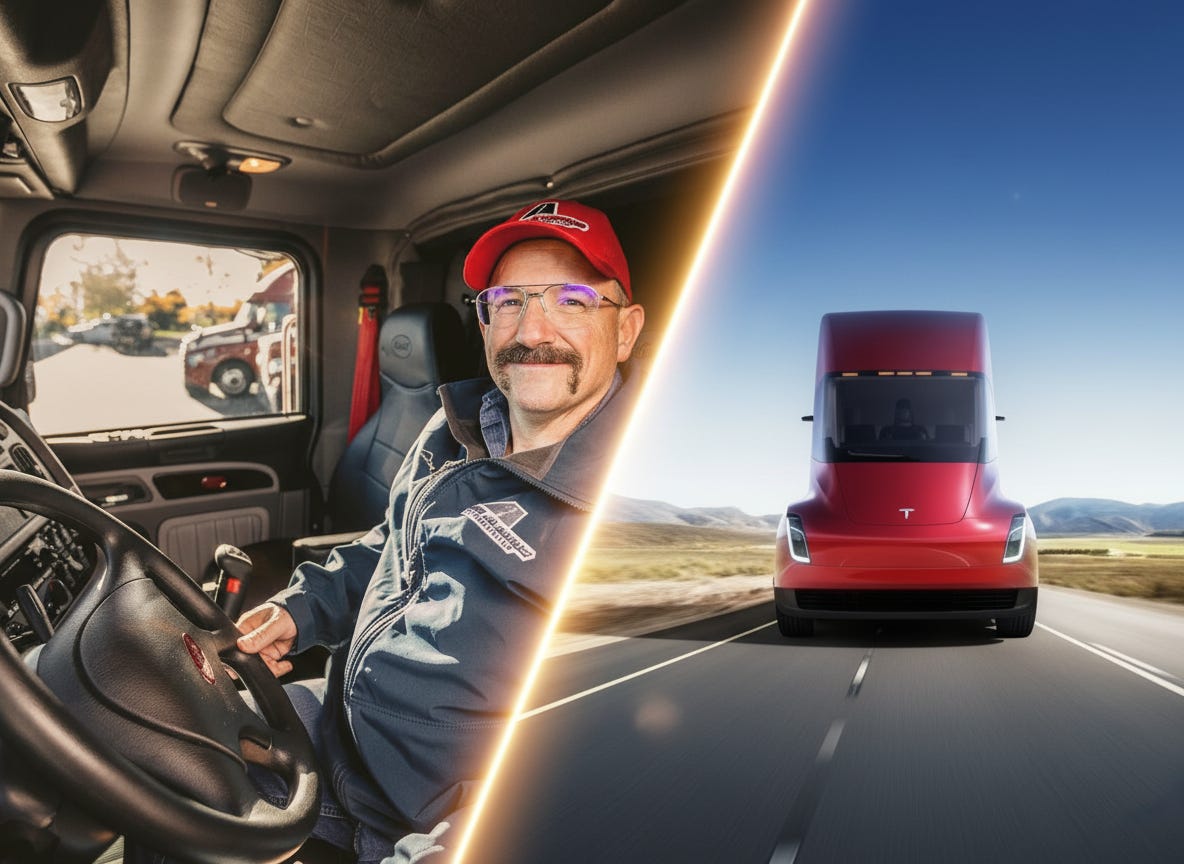
The freight industry is experiencing a once-in-a-generation collision between renewed union power and accelerating automation. For supply chain leaders, logistics operators, and investors, the outcome will reshape labor costs, operational strategy, and competitive positioning over the next decade.
The Current Situation: Unions Are Stronger Than They Look
Union membership in transportation and warehousing sits at 15.8%—among the highest in the private sector. More importantly, the Teamsters just secured their largest wage gains in decades. In 2024, major carriers like ABF and TForce agreed to 24% wage increases over five years and to explicit protections against the deployment of autonomous vehicles.
This sounds like a union victory. It’s actually a tactical win that masks a strategic vulnerability.
The reason? These gains occurred in a tight labor market where carriers couldn’t find drivers. That advantage evaporates the moment autonomous trucks become commercially viable—which is happening faster than most executives realize.
The Automation Timeline Is Closer Than You Think
The autonomous truck industry reached $1.9 billion in valuation in 2023, with projections hitting $13.6 billion by 2030
Level 4 autonomy trucks are already operating on limited routes in Texas, Arizona, and Nevada
Industry forecasts expect autonomous vehicles to handle 50-70% of long-haul transport by 2030
Warehouse automation is accelerating even faster, with robot shipments expected to grow 50% annually through 2030
The real shock: warehousing employment growth will slow to just 5.9% between 2023-2033, despite overall logistics demand growing 15-20% annually. That gap is automation.
Three Operational Scenarios for Your Business by 2030
Long-Haul Trucking: The First Domino Falls (Probability: 80% of major carriers affected)
The Teamsters’ contracts currently prohibit autonomous vehicles, but don’t expect these protections to survive beyond 2027. Here’s why:
Autonomous trucks cut driver costs by 40% while enabling 24/7 operation. That economics is too powerful to resist. Carriers will face a choice: automate or lose competitiveness to non-union competitors and autonomous-first startups.
What happens next: By 2027-2028, expect major carriers to propose contract amendments allowing “autonomous operation with human safety monitors.” The union will negotiate hard but ultimately accept a transition model. Drivers won’t disappear; the ratio will shift from one driver per truck to one monitor per 3-4 autonomous trucks.
For your supply chain: If you currently negotiate with union carriers on rates, expect labor agreements to stabilize post-2028 as automation becomes the norm. Today’s wage escalations will be offset by productivity gains.
Warehousing: The Hidden Automation Story
Warehouses reveal automation’s true impact. Robots haven’t eliminated warehouse jobs—they’ve intensified them.
Research shows warehouses with heavy automation have:
40% fewer severe injuries
77% more non-severe injuries (strain, fatigue, overuse)
Translation: Workers are staying on the job longer but experiencing higher injury rates because robots demand 2-3x faster pick rates. This is a quality-of-work problem, not a quantity-of-jobs problem.
Union leverage here is different. Warehousing locals can’t prevent automation, but they can negotiate for:
Realistic performance metrics that account for human fatigue
Mandatory task rotation
Human-led quality control oversight
For your supply chain: Expect warehouse labor agreements to focus increasingly on job quality metrics (injury rates, turnover) rather than headcount. This is actually more predictable for planning purposes.
Ports: The Stronghold Under Siege
Port unions have successfully resisted automation for decades. But the 2024 ILA confrontation over autogates reveals a critical weakness: the union resisted technology that had been operating since 2008.
This reactive approach is costing them market share. Automated ports in British Columbia, Rotterdam, and soon Mexico are stealing volume from restrictive U.S. ports. The actual threat to port union jobs isn’t the technology—it’s that shippers will simply bypass unionized ports entirely.
For your supply chain: If you use U.S. East or Gulf Coast ports, anticipate higher dwell times and labor costs through 2026-2027 as the ILA negotiates automation terms. West Coast ports (ILWU-represented) will likely accept selective automation faster than East Coast ports.
Implications for Different Executive Roles
If You’re a Carrier or Logistics Operator
Your immediate priority: Map your fleet and warehouse automation roadmap against current union contracts. Identify expiration dates and prepare negotiating positions that frame automation as “transition” rather than “replacement.”
Key insight: The union leaders who negotiate automation terms today will be remembered as managers of decline, not fighters against it. This gives you leverage if you frame the conversation around job security during transition rather than job elimination.
Realistic timeline: Major automation deployments won’t happen until 2028-2030, giving you 3-4 years to negotiate favorable terms.
If You’re a Board Member
Key data point: Union density in transportation will likely decline from 15.8% to 8-10% by 2035. This compression creates alpha opportunities for carriers that automate early while union competitors are still negotiating.
Three safe bets:
Autonomous trucking startups (Waymo, Aurora, Kodiak)—first-mover advantage is substantial
Legacy carriers with profitable automation adoption (think J.B. Hunt, Schneider)—consolidation will reward operators with transition capital
Avoid: Union-heavy carriers dependent on contract wage escalations without corresponding automation plans
If You’re a Policy Maker or Union Leader
The uncomfortable truth: Preventing automation is strategically impossible. The question is whether you manage the transition or suffer a collapse.
The 2024 ABF contract model offers a template: accept automation while negotiating for higher wages, profit-sharing, and retraining funds. But this requires unions to pivot from “prevent automation” to “manage automation”—a psychological shift many organizations aren’t prepared to make.
The Three Most Likely Scenarios for 2035
Scenario 1: Negotiated Transition (35% probability)
What it looks like: Teamsters and port unions recognize automation’s inevitability and shift to managing displacement. Autonomous trucks operate with reduced crews; displaced drivers get guaranteed income and retraining. Warehousing unions focus on productivity-sharing and job quality.
Your supply chain implication: Labor costs stabilize at predictable levels as union power shifts from wage negotiation to technology governance.
Key requirement: Federal transition funding (similar to German co-determination model). Without it, this scenario collapses into Scenario 2.
Scenario 2: Slow-Motion Collapse (45% probability)
What it looks like: Unions win isolated contract battles while losing the war. Individual carriers automate on non-union lanes. Non-union competitors (Amazon, autonomous startups) capture market share. Union density declines to 8-10%.
Your supply chain implication: Increasing fragmentation between union and non-union logistics. Your costs depend heavily on whether you operate in union strongholds (ports, LTL) or non-union segments (long-haul, e-commerce).
Key risk: Periodic labor disruptions as unions fight rearguard actions, creating supply chain volatility through 2030.
Scenario 3: Existential Confrontation (20% probability)
What it looks like: Unions attempt comprehensive work stoppages to halt automation. Carriers accelerate automation plans, shift freight to Mexico and Canada. Congress imposes settlement heavily favoring carriers.
Your supply chain implication: Severe disruption for 6-12 weeks, followed by rapid automation deployment. Permanent route changes away from unionized corridors.
Probability increasing if: Union leadership changes to more militant figures; recession triggers aggressive cost-cutting by carriers.
The Critical Variables That Will Determine Your Outcome
1. Regulatory Fragmentation
States with permissive autonomous vehicle rules will become automation hubs
Expect major carriers to concentrate autonomous fleets in TX, AZ, FL, CA
If you operate in restrictive states, automation timelines shift 2-3 years later
2. Labor Market Dynamics
The current 1.7 million transportation job openings give unions short-term leverage
This advantage evaporates as automation matures (by 2028)
If labor scarcity persists (recession doesn’t hit), automation deployment accelerates
3. Economic Conditions
Recession = faster automation adoption (cost-cutting)
Growth = delayed automation (capital constraints, labor availability)
Current trajectory suggests no major recession through 2027, so expect accelerated deployment
4. Union Strategic Cohesion
Teamsters are moving aggressively under Sean O’Brien
ILWU and ILA are more defensive
Without a coordinated strategy, carriers will exploit fragmentation
Key Takeaways for Your Business
The freight labor crisis isn’t structural—it’s technological. Automation is solving the driver shortage problem, not the other way around.
Union contracts will look different after 2027. Expect fewer wage escalators, greater acceptance of automation, and profit-sharing replacing fixed wage increases.
Your automation timeline should match—not lag—industry trends. Waiting until 2030 means paying premium rates for late-stage transition.
Port automation will happen, despite ILWU/ILA resistance. The economic pressure is too great. Plan for selective automation at U.S. ports by 2027.
Warehouse automation is the safer bet. Unions can’t prevent it, but they can negotiate job quality. This creates stability you can plan around.
Supply chain fragmentation is the real risk. Union strongholds (ports, LTL) will coexist with fully automated segments (long-haul, e-commerce). Your strategy needs to handle both.
The Bottom Line
The freight unions’ greatest challenge isn’t technology—it’s conceptual. They need to transform from organizations that sell labor into ones that manage technological transition. The ones that accomplish this will survive, changed but viable. The ones that don’t will become historical curiosities, remembered for their final stands.
For you as an executive, the opportunity is clear: the next 3-4 years are your window to negotiate automation terms while unions still have leverage. After 2027, automation becomes the baseline, not the negotiation point.
The freight industry of 2035 will have 30-40% fewer drivers and warehouse workers than today, but those remaining jobs will be higher-value roles focused on exception handling, customer service, and system oversight. The question for your business is whether you’ll lead that transition or chase it.