
UPS Is Putting $48 Million Behind the Future of Premium Freight
How a cold-chain expansion is redefining premium freight, pricing power, and who wins the next freight cycle


UPS has made a decisive investment in the future of freight margins by allocating $48 million to 27 temperature-controlled facilities across the Americas, Europe, and Asia. This expansion strengthens its cold-chain network for pharmaceuticals, biologics, and other high-value shipments that require strict temperature control and timely delivery.
This development has implications beyond parcel delivery. For executives, investors, carriers, forwarders, and network planners, it signals a clear distinction between premium and commodity freight. UPS is strategically investing in lanes, cargo types, and service requirements that provide greater pricing power, stronger customer retention, and improved margins.
$48 Million Investment
According to CNBC, UPS will invest $48 million to enhance 27 temperature-controlled facilities across its domestic and international operations, focusing on key markets in the Americas, Europe, and Asia. These facilities are designed to handle shipments requiring strict temperature control. UPS states that this Investment aims to improve speed and the end-to-end chain of custody as demand for medicines, including certain GLP-1 drugs, increases.
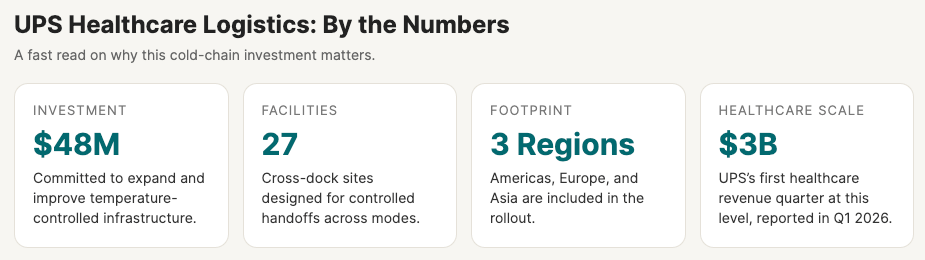
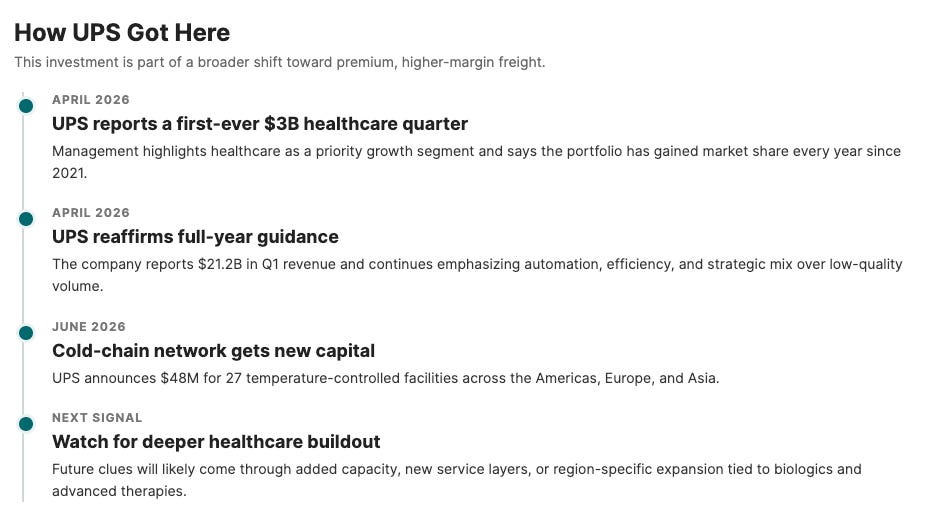
UPS executives have been laying the groundwork for this move for months. On the company’s first-quarter earnings call, CEO Carol Tomé said healthcare remains one of UPS’s top priorities and added, “Our global healthcare portfolio has gained market share every year since 2021,” while noting that UPS generated its first-ever $3 billion healthcare revenue quarter in Q1 2026.
This strategy is part of a broader network transformation. UPS reported $21.2 billion in Q1 2026 revenue, reaffirmed its full-year guidance of approximately $89.7 billion, and described itself as being in a “critical transition period” focused on strategic initiatives, automation, and network efficiency instead of prioritizing volume growth at any cost.
Why Now?
Cold chain is where freight complexity turns into pricing power. Temperature-sensitive healthcare shipments require certified handling, tighter transfer windows, better monitoring, and more disciplined chain-of-custody controls than standard parcel or general freight. That operational difficulty is exactly what makes the category attractive.
UPS is directing Investment toward market segments where service failures are costly and reliability is highly valued. CNBC, referencing Growth Market Reports, projects that demand for temperature-sensitive biologics will grow at an 8.3% compound annual rate through 2033, reaching approximately $39.1 billion. The World Health Organization reports that up to 50% of global vaccines are wasted annually, with a significant portion attributed to cold-chain failures.
For freight operators, the message is clear: the market now rewards operational capability over mere capacity. Providers that can ensure validated temperature ranges, reliable handoffs, and effective exception management access higher-margin opportunities than those competing solely on price.
Network Read
The most important part of this announcement may be the facility type itself. These are cross-dock facilities optimized for speed and short-term storage between air and ground movements, which means UPS is strengthening the transfer points where premium freight often faces its biggest execution risk.
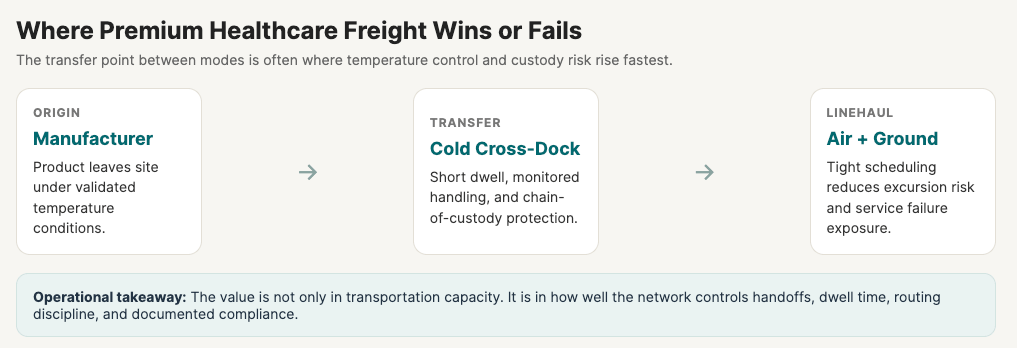
This development affects all transport modes. Air cargo benefits, as healthcare freight often requires urgent, tightly scheduled uplift. Trucking and drayage gain value from increased precision in first-mile, last-mile, and transfer operations. For warehousing and fulfillment, regulated temperature integrity is becoming central to healthcare network design rather than a niche service.
The infrastructure investment extends beyond physical buildings. Cold rooms, validation systems, monitoring, disciplined routing, and documented handling standards all contribute to a more defensible freight offering. Once a provider is qualified for sensitive healthcare shipments, the resulting business is typically more stable due to operational, regulatory, and reputational switching costs.
Global Freight
This development reflects broader trends in the global supply chain. By deploying assets across the Americas, Europe, and Asia, UPS is strengthening key corridors for pharmaceutical manufacturing, clinical supply, biologics distribution, and specialized healthcare trade.
The regional distribution is significant as healthcare supply chains are increasingly international in sourcing and fulfillment. A premium cold-chain network is only as reliable as its weakest transfer point, making geographic consistency a competitive advantage. Global shippers are therefore prioritizing providers that can maintain consistent standards across various customs zones and modes of transport.
Emerging markets are also relevant, even though UPS’s announcement focused on broader regions rather than specific countries. As advanced therapies, diagnostics, and chronic-disease treatments expand into rapidly growing healthcare markets, supporting trade lanes will require improved temperature integrity, greater visibility, and enhanced contingency planning.
Takeaways
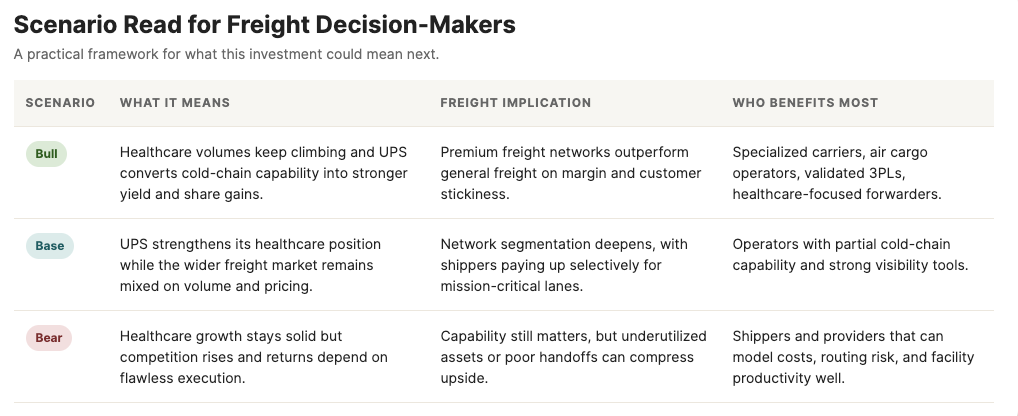
Premium freight is becoming increasingly differentiated. UPS is investing in freight that is less interchangeable, more operationally complex, and more profitable.
Cross-dock quality has become a strategic asset. The transfer between air and ground is a critical point for cold-chain risk, making transfer infrastructure as important as long-haul capacity.
Healthcare is becoming a margin hedge. UPS said healthcare accounted for more than 14% of consolidated revenue in Q1 2026, following its first $3 billion healthcare quarter, giving the company greater exposure to resilient, higher-value demand.
Network planning is shifting from prioritizing the lowest cost to emphasizing the safest route. For sensitive freight, route design must increasingly account for temperature control, dwell time, exception handling, and custody visibility.
Procurement teams should expect segmentation to widen. Providers with certified cold-chain infrastructure and proven healthcare handling will not price like generalist networks, and many shippers will accept that premium.
A Sharper Industry Perspective
This announcement also carries a message for investors. UPS continues to indicate that future growth will rely less on broad parcel expansion and more on targeted investments in premium segments such as healthcare, SMB, and B2B. This aligns with management’s broader strategy to improve business mix, automate the network, and protect margins even if overall revenue growth is modest.
For operators, the key takeaway is not to become a pharmaceutical specialist immediately, but to recognize that a larger share of industry profits is shifting toward controlled, time-sensitive, high-value freight. Companies lacking cold-chain, compliance, or visibility capabilities may still handle volume, but are less likely to secure the most valuable network segments.
Enhanced freight intelligence is becoming increasingly important. As the market divides between commodity and premium lanes, decision-makers require improved cost visibility, more precise routing, and better risk assessment before service disruptions occur. In this environment, tools such as FreightFA become essential for operational discipline rather than just marketing.
What to watch next
Monitor whether UPS follows this Investment with more detailed disclosures about its healthcare network, particularly regarding utilization, regional expansion, and services related to biologics and advanced therapies. Tomé has stated that the company will continue to invest significantly in the sector, indicating this is likely part of a broader strategy rather than an isolated initiative.
Monitor competitors as well. If UPS continues to gain market share in healthcare and demonstrates strong margins, other major operators will be pressured to expand certified temperature-controlled networks, strengthen partnerships in pharmaceutical handling, or acquire specialized assets.
Also, observe the growing divide within the freight market. As more capital is invested in resilient, complex, and specialized logistics, it becomes increasingly clear that not all freight demand is equally valuable. In this cycle, access to premium freight may become more important than overall volume.