


Key Highlights
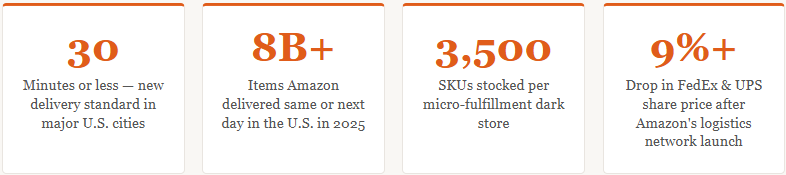
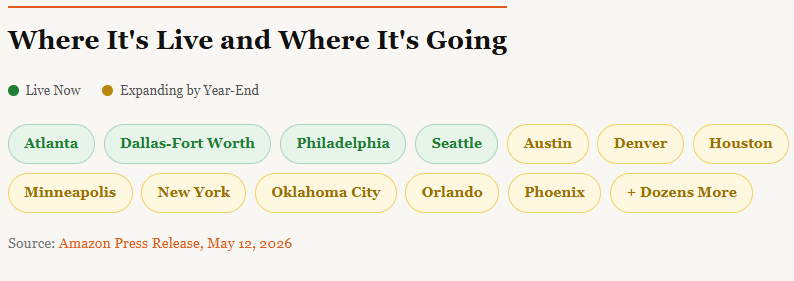
Amazon Now launches nationwide, offering 30-minute delivery in Atlanta, Dallas-Fort Worth, Seattle, and Philadelphia, with expansion to New York City, Houston, Denver, Orlando, Phoenix, and additional cities by year-end.
Approximately 3,500 SKUs are stocked in dark stores similar in size to a CVS and fulfilled using AI-driven demand models.
Pricing is $3.99 per order for Prime members, $13.99 for non-Prime customers, and a $1.99 small basket fee applies to orders under $15.
Eight days ago, Amazon opened its logistics network to P&G, 3M, and American Eagle. Following this, FedEx and UPS shares declined by more than 9%.
Amazon delivered 8 billion items same- or next-day
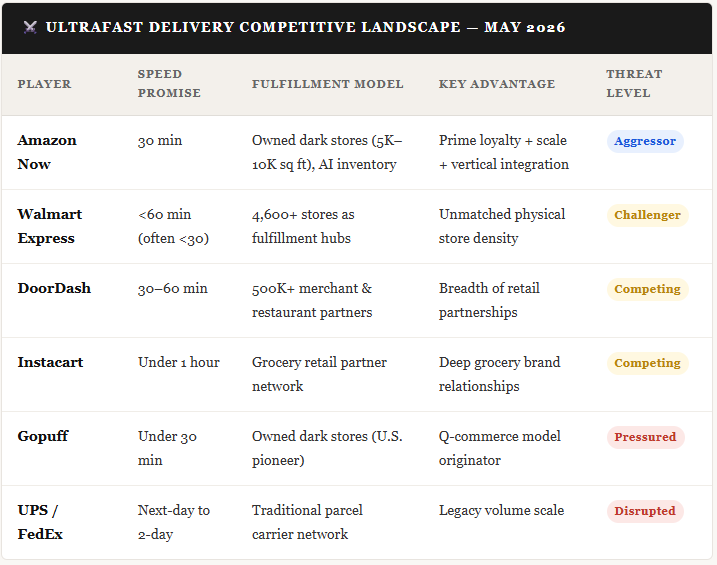
Walmart, DoorDash, and Instacart are ramping up their efforts, yet none have the infrastructure depth of Amazon.
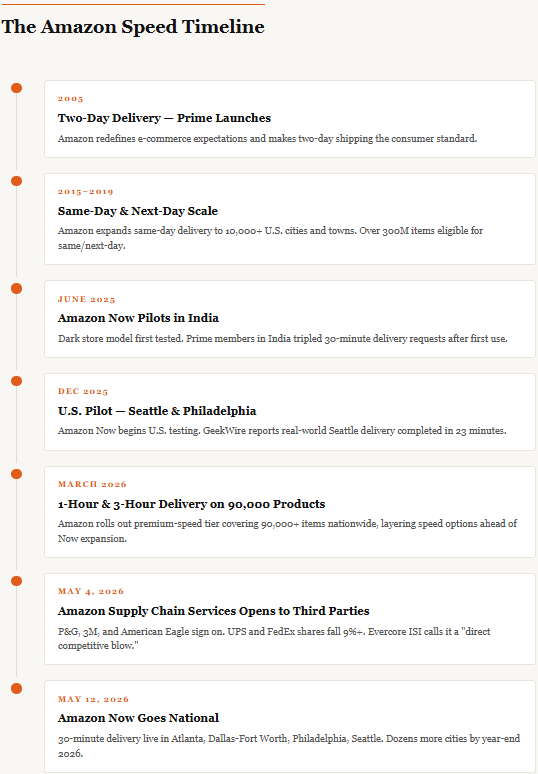
In 2005, Amazon redefined consumer expectations with two-day shipping. By 2015, same-day delivery became standard. Today, Amazon has raised expectations again. This shift is not only about retail, but also about control over the physical infrastructure of urban commerce.
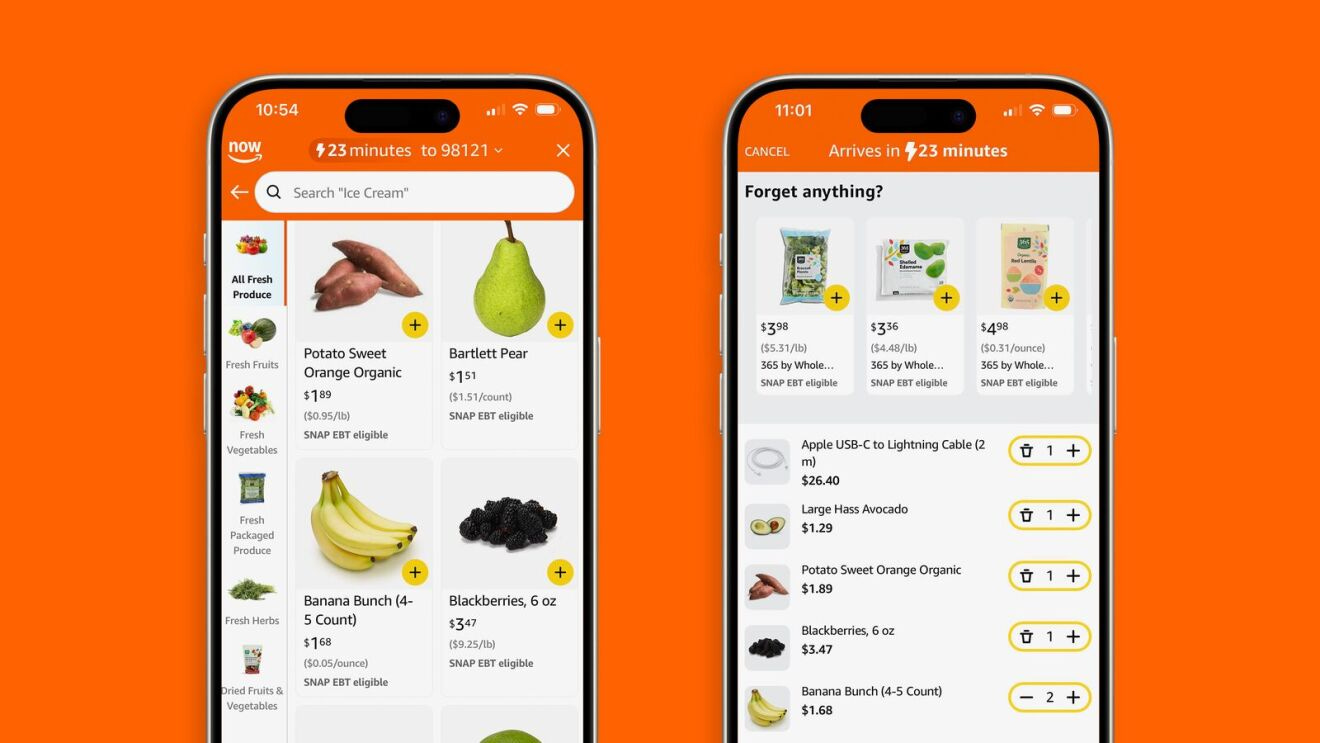
Amazon Now, the company’s ultrafast delivery service, launched nationwide on May 12, 2026. Customers in Atlanta, Dallas-Fort Worth, Philadelphia, and Seattle can already receive groceries, electronics, pet supplies, and household essentials within 30 minutes. By the end of 2026, the service is expected to reach tens of millions of customers in dozens of additional U.S. cities.
For executives and investors in freight and supply chain, this is not a product launch to overlook. Vertical integration is unfolding in real time, and the window to respond is narrowing.
How Amazon Now Actually Works
Amazon Now is not a rebrand of same-day delivery. It is a fundamentally different fulfillment model built around urban micro-fulfillment centers, known in the industry as “dark stores.” These facilities range from 5,000 to 10,000 square feet, similar to a CVS drugstore, and stock approximately 3,500 of the most frequently ordered items. They are located close to where customers live and work, rather than near highway interchanges.
“We know that customers love speed and always have. What we see customers doing, when we offer faster speeds, is they purchase more from Amazon. And Amazon becomes more top of mind.”
— Beryl Tomay, Head of Transportation, Amazon (AP News, May 12, 2026)
Unlike Amazon’s large fulfillment centers, which use robotics and hundreds of workers to pick and pack millions of SKUs, Amazon Now hubs operate with only a small team. AI and machine learning drive the inventory model, analyzing what customers in each neighborhood buy, how often, and when. The top U.S. sellers so far are soap, toothpaste, bananas, toilet plungers, and wireless earbuds. These items are practical, immediate, and predictable.
Amazon SVP of Worldwide Operations Udit Madan framed the service clearly in the official press release: “Amazon Now is for when you need or want the convenience of getting your Amazon order delivered in 30 minutes or less — everything from groceries for dinner, to AirPods before a flight, to household essentials like laundry detergent or toothpaste.”
Who’s Racing — and Who’s at Risk
Amazon is not operating in isolation. Walmart has been advancing its own rapid delivery capabilities. CEO John Furner stated in February that many Walmart Express Delivery customers, who pay an extra $10 for guaranteed one-hour delivery on over 100,000 products, are actually receiving orders in under 30 minutes. This directly aligns with Amazon Now’s promise, enabled by Walmart’s network of more than 4,600 stores, which serves as a distributed fulfillment infrastructure.
DoorDash, Instacart, Uber Eats, and Grubhub also operate in the last-mile delivery space. Independent retail analyst Bruce Winder told AP News, “What Amazon brings is their prowess in supply chain.” The scale disparity is significant. DoorDash responded, “We win only when they win,” referencing its 500,000-plus grocery and retail items across partner merchants. DoorDash is positioning itself as infrastructure for retailers rather than as a direct competitor.
Implications for Freight, Carriers, and 3PLs
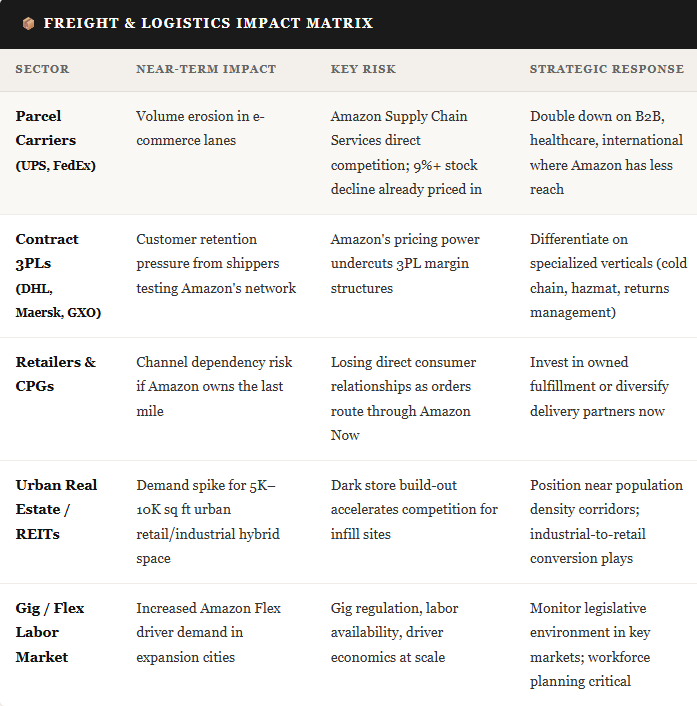
While the 30-minute delivery announcement is notable, the freight industry should consider the broader context. Amazon Now is the consumer-facing element of a larger infrastructure strategy. Eight days ago, Amazon launched Amazon Supply Chain Services, opening its fulfillment, freight, and distribution network to external businesses. P&G, 3M, and American Eagle have already joined. Following the announcement, FedEx and UPS shares dropped by more than 9%. Analysts at Evercore ISI described it as a “direct competitive blow” to parcel carriers and noted that contract logistics providers such as DHL Supply Chain, Maersk Logistics, and GXO are “significantly vulnerable.”
The Bigger Picture: Amazon’s Full Logistics Stack
Amazon has assembled more than 100 cargo aircraft, second only to FedEx and UPS, along with a national network of fulfillment centers and sorting hubs. Amazon Pharmacy offers same-day delivery in 4,500 U.S. cities, and same-day grocery delivery is active in over 2,300 cities and towns. Prime Air drone delivery operates in nine U.S. locations, and urban dark stores now provide 30-minute delivery in every major metropolitan area. This represents a vertically integrated logistics stack, covering long-haul air freight to the final 100 yards of neighborhood delivery.
“It also marks a potential shift in a U.S. logistics industry long dominated by FedEx and UPS.”
— Reuters, May 4, 2026, on Amazon Supply Chain Services launch
Forrester Research analyst Sucharita Kodali notes that the 30-minute model faces significant unit economics challenges. It requires a sufficient number of customers placing concurrent orders from the same or nearby areas to be cost-effective at scale. The failure of 10- to 15-minute grocery startups during the pandemic serves as a cautionary example. Amazon will not guarantee delivery times; Beryl Tomay confirmed they will keep customers updated on order progress rather than promise a specific window. This measured approach is prudent. However, Amazon benefits from a 200-million-member Prime ecosystem already accustomed to using the app first.
Key Considerations for Your Business
Amazon’s strategy is clear: dominate the urban delivery corridor. This includes dark stores in urban centers, AI-driven demand prediction, on-call Flex drivers, and the Prime ecosystem, all of which encourage repeat purchases. Additionally, Amazon now offers logistics-as-a-service, allowing it to generate revenue even when fulfilling orders for competitors.
The key question for every freight operator, 3PL, retailer, and logistics investor is not whether Amazon is disrupting your market, but how much of the urban delivery infrastructure you control. Consider your strategy before year-end, when tens of millions more customers will be part of the Amazon Now ecosystem.
Speed is no longer a differentiator. For the urban last mile, it is now a basic requirement.
Know Your Freight Cost Position
As delivery speed becomes the floor, freight cost visibility becomes the strategic edge. FreightFA’s AI-powered platform gives logistics decision-makers real-time cost estimates across modes and markets — so you’re never guessing what it costs to compete.
Sources
Amazon Official Press Release — “Amazon Rolls Out Amazon Now to Dozens of Cities,” May 12, 2026
Reuters — “Amazon opens up its logistics network to other businesses,” May 4, 2026
CNBC — “Amazon opens up its logistics network to other businesses,” May 4, 2026
Cybernews — “Amazon just became a direct competitor to UPS and FedEx,” May 4, 2026
USA Today — “Amazon’s 30-minute delivery expands to more cities,” May 12, 2026


