


Key Highlights
Dollar Tree opened a 1M sq. ft. distribution center in Litchfield Park, AZ — the company’s most strategically positioned DC yet
75% of total freight volume is now locked in multi-year contracts, slashing spot market exposure to roughly 2%
In 2021, freight chaos cost Dollar Tree $1.50–$1.60 per share in earnings. That playbook has been permanently retired
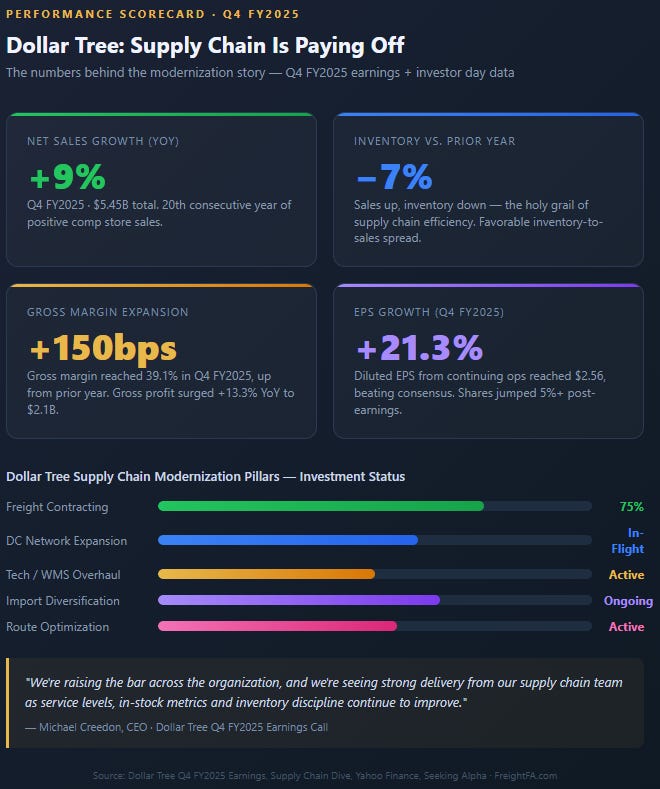
Q4 FY2025: Sales +9% YoY, inventory down 7% — one of the strongest inventory-to-sales spreads in retail
Gross margins expanded 150 basis points to 39.1%, with EPS growth of +21.3%
A second DC replacing the tornado-destroyed Marietta, Oklahoma facility is on track for Spring 2027
Legacy WMS systems — some decades old — being replaced with cloud-based, AI-enabled platforms
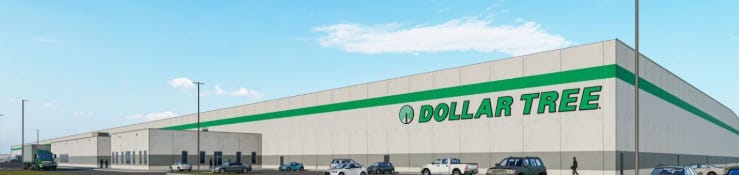
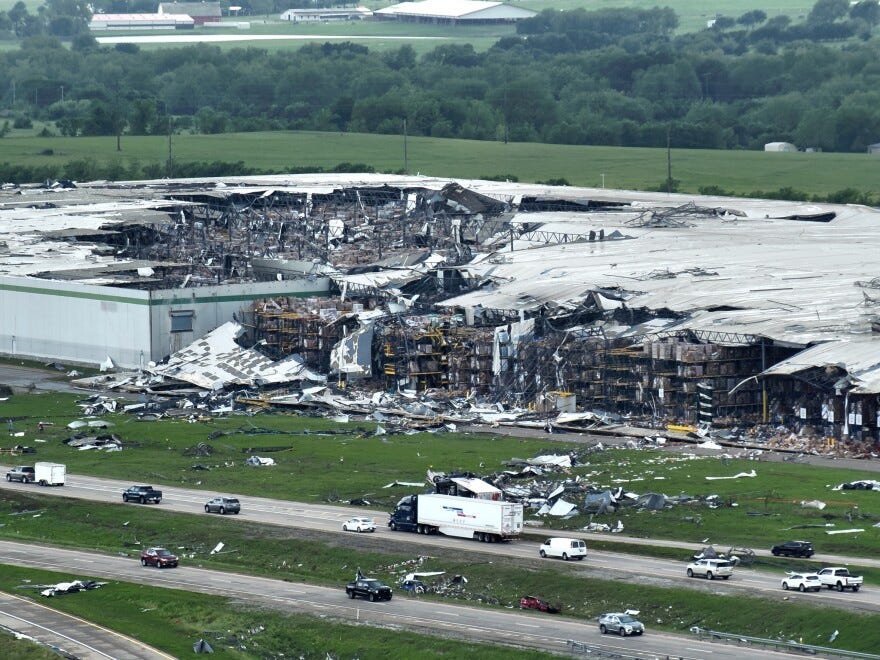
In April 2024, an EF-4 tornado destroyed Dollar Tree’s distribution center in Marietta, Oklahoma, highlighting the vulnerability of the company’s supply chain. The loss of the million-square-foot facility led to increased transportation costs and longer delivery routes. Already under scrutiny due to the Family Dollar divestiture, Dollar Tree was forced to address these challenges immediately.
This event prompted one of the most focused supply chain rebuilds in the retail sector.
Two years later, Dollar Tree is opening new distribution centers, securing multi-year freight contracts, and replacing outdated technology. For freight executives, investors, and logistics strategists, this serves as a model for disciplined logistics investment aimed at margin protection.
The Tornado That Changed Everything
The Marietta, Oklahoma distribution center was a critical part of Dollar Tree’s 16-center network, which supplies approximately 90% of store inventory. Its destruction immediately reduced distribution capacity, increased transport distances, and raised freight costs, impacting both financial performance and service levels.
Chief Supply Chain Officer Roxanne Weng described it directly at Dollar Tree’s 2025 Investor Day: the facility’s destruction “led to higher transportation costs due to reduced distribution capacity, which further strained Dollar Tree’s network and added transport miles.”
Supply chain professionals recognize this pattern: losing a facility increases costs and compresses margins, requiring rapid recovery. Dollar Tree approached the rebuild with a new strategy.
Two DCs, One Strategic Vision
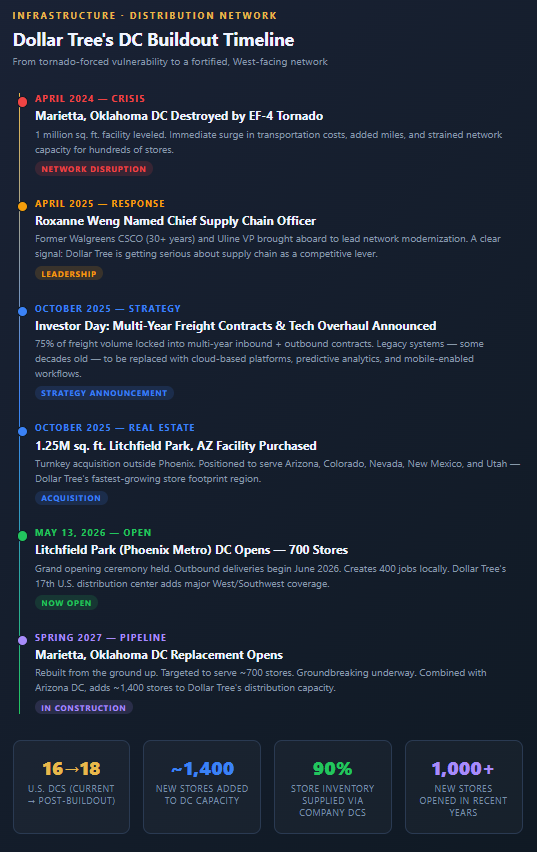
Dollar Tree’s infrastructure response consists of two key initiatives.
Move 1: Litchfield Park, Arizona (Open — May 13, 2026)
The company opened a 1-million-square-foot distribution center in Litchfield Park, near Phoenix, on May 13, 2026. This 1.25 million square foot turnkey facility, acquired in October 2025, will begin outbound deliveries in June 2026 and is expected to serve approximately 700 stores across Arizona, Colorado, Nevada, New Mexico, and Utah. The center is creating 400 jobs in the Phoenix metropolitan area.
This facility is not a backup; it is a strategic decision. The Southwest is one of Dollar Tree’s fastest-growing markets, and locating a large distribution center nearby directly reduces transit times and delivery costs.
Move 2: Marietta, Oklahoma Replacement (Spring 2027)
Construction has begun on the replacement distribution center in Marietta. Scheduled to open in Spring 2027, it will serve approximately 700 stores, restoring and surpassing the capacity lost in 2024. Combined, the two new facilities will add about 1,400 store positions to Dollar Tree’s distribution network, supporting the company’s recent expansion.
Weng summarized the long-term thesis plainly: “Our goal is to capture the right capacity in the right locations, aligning our distribution capabilities with store expansion. This minimizes miles and product touch points.”
The Freight Contract Play Every Logistics Professional Should Study
This development is particularly relevant for the freight community.
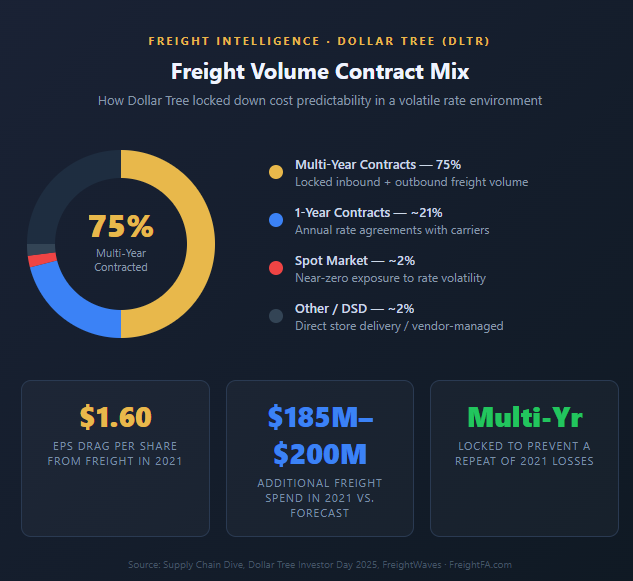
At the 2025 Investor Day, Weng disclosed that Dollar Tree had secured multi-year inbound and outbound freight contracts covering approximately 75% of its total freight volume. The remaining mix skews heavily toward one-year contracts, with spot market exposure trimmed to roughly 2%.
To understand the significance, consider the events of 2021.
When global freight markets seized — container shortages, port congestion, carrier capacity constraints — Dollar Tree was exposed. The company disclosed that elevated transportation expenses would drag full-year earnings by $1.50 to $1.60 per share versus the prior year, with an additional $185 million to $200 million in freight spend layered on top of their original forecast. The revised full-year EPS range fell 7% below the prior guidance — and below the prior year’s actual result.
This scenario illustrates the risks that multi-year contracting is intended to mitigate.
Securing 75% of freight volume through multi-year agreements achieves three objectives:
Removes rate volatility from the majority of transportation spend
Improves cost predictability for financial planning and margin modeling
Creates service reliability — contracted carriers have committed capacity, not just spot availability
For carriers included in that 75%, this provides long-term volume stability on key routes. For others, Dollar Tree remains inaccessible until the next contract cycle.
Technology: The Multiplier Nobody’s Talking About
While physical infrastructure receives public attention, technology delivers significant operational advantages.
Dollar Tree is in the middle of replacing legacy warehouse and yard management systems — some of which were literally decades old — with cloud-based platforms, predictive analytics tools, and mobile-enabled workflows. CEO Michael Creedon framed the scope at Investor Day: “These investments in our IT and supply chain infrastructure are highly transformative.”
The result is higher throughput per distribution center without expanding square footage. Serving more stores from the same footprint increases efficiency, reduces miles, lowers cost per unit shipped, and improves inventory management.
The results are already visible in the numbers. In Q4 FY2025, Dollar Tree reported inventory down 7% year-over-year while sales were up 9% — a favorable inventory-to-sales spread that reflects better demand forecasting, smarter assortment planning, and tighter inbound flow management. Gross margins expanded 150 basis points to 39.1%, with gross profit up 13.3% to $2.1 billion.
Import Diversification: Quietly De-Risking the Upstream
The domestic freight story is only half of it. Dollar Tree is also restructuring its import strategy — a critical move in a tariff environment where single-country sourcing concentration has become a liability.
Weng addressed it directly: “We’re also strengthening our import strategy by diversifying where product comes from and balancing volume across carriers and ports. That gives us more flexibility to respond to global changes.”
In practice, this means diversifying sourcing to reduce risk. Given ongoing tariff uncertainty, distributing sourcing across multiple origins and carrier partnerships enables Dollar Tree to manage supply disruptions, such as trade restrictions, shipping route interruptions, or port labor actions, without causing a network-wide crisis.
For ocean carriers and freight forwarders, Dollar Tree’s diversification strategy creates new lane opportunities. Ports may also benefit as inbound volume shifts with the implementation of this strategy.
The Person Behind the Plan
Effective leadership has been essential to these changes. Roxanne Weng became Dollar Tree’s Chief Supply Chain Officer in April 2025, succeeding retiring CSCO Mike Kindy. Weng brings over 30 years of experience at Walgreens, where she served as CSCO, and later as VP of Creative Operations at Uline. She has extensive expertise in high-volume, complex retail logistics.
Her appointment signaled a shift in strategy. Dollar Tree committed to addressing supply chain constraints that had previously affected margins. Within months, the company announced the Litchfield Park acquisition and introduced the multi-year freight contracting strategy at Investor Day.
The freight industry should view Roxanne Weng as a strategic counterpart, not solely as a shipper executive.
What This Means for the Freight Market
Dollar Tree’s actions have market implications that reach beyond the company’s own financial performance:
Southwest lane capacity is changing. The Litchfield Park facility will generate new outbound volume across Arizona, Colorado, Nevada, New Mexico, and Utah beginning in June 2026. Carriers operating in these lanes should begin discussions promptly.
Multi-year contract adoption is increasing. By securing 75% of its freight in multi-year agreements, Dollar Tree reduces the available spot market capacity on these routes. This may lead to increased spot rate pressure in the company’s primary corridors.
Shippers with advanced technology secure better rates. Dollar Tree’s warehouse and yard management system upgrades will improve carrier performance metrics, streamline dock appointments, and increase efficiency, making the company a more attractive partner for carriers.
Smaller dollar-store chains lacking this infrastructure are losing competitive ground. The gap between retailers who invest in supply chain technology and those who do not continues to widen each quarter.
Conclusion
Dollar Tree’s supply chain rebuild is a comprehensive capital allocation strategy supported by tangible infrastructure, contracts, and financial outcomes. The transition from significant freight cost challenges to 75% multi-year contracted coverage, from outdated systems to cloud-based platforms, and from a destroyed distribution center to two new strategic facilities demonstrates a complete transformation of the supply chain.
For freight professionals and investors, the key question is not whether Dollar Tree’s strategy is effective—the results are clear—but how it will impact transportation lanes, contracts, and carriers in the broader market.
To benchmark your freight cost exposure against companies like Dollar Tree, FreightFA.com offers AI-powered freight cost estimates. This enables data-driven decision-making for your next contract negotiation.
Sources:
Dollar Tree Logistics Resiliency — Supply Chain Dive (May 2026)
Dollar Tree Distribution & Tech Upgrades — Supply Chain Dive (March 2026)
Dollar Tree Q4 FY2025 Earnings — Seeking Alpha / Yahoo Finance
Dollar Tree Litchfield Park DC Opening — Dollar Tree Corporate (May 2026)
Dollar Tree Tariff / Spot Market Exposure — Supply Chain Dive


