


The Story
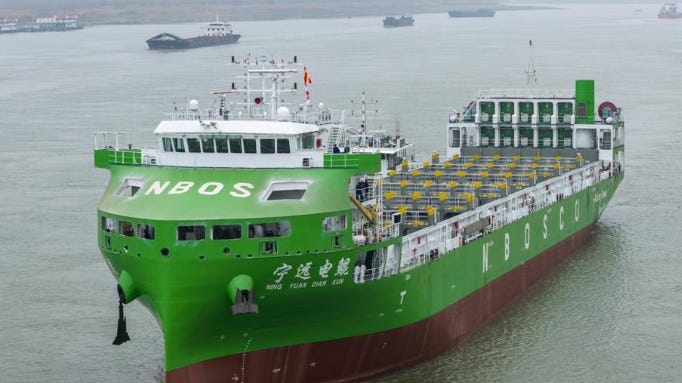
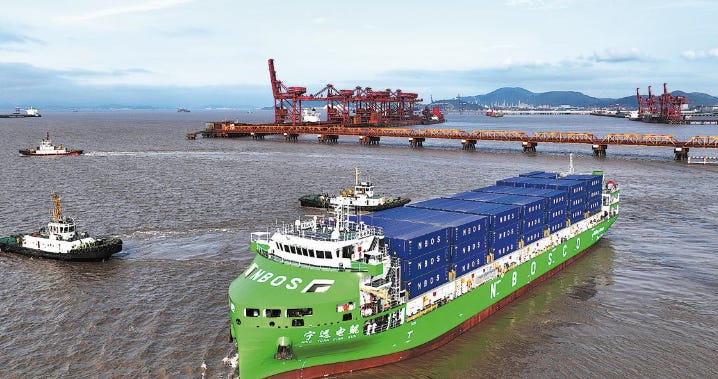
Shipping has seen many high-profile decarbonization announcements, but few have demonstrated commercial viability. The Ning Yuan Dian Kun stands out for this reason. According to China Daily, the vessel was delivered in Ningbo in April after completing its tests and is now operating on the coastal route between Ningbo and Jiaxing, rather than remaining in demonstration mode.
This distinction is critical for executives, investors, and infrastructure planners. A vessel in commercial service provides insights that prototypes cannot, such as turnaround time, energy management, port readiness, crew adaptation, and route economics.
The Vessel
The ship was built by Jiangxi Jiangxin Shipbuilding for Ningbo Ocean Shipping and is described by both The Maritime Executive and China Daily as the world’s largest all-electric container vessel of its kind. It measures 127.8 meters long, 21.6 meters wide, carries more than 740 TEUs, and uses two permanent-magnet propulsion motors powered by 10 container-shaped battery units totaling about 19,600 kWh.
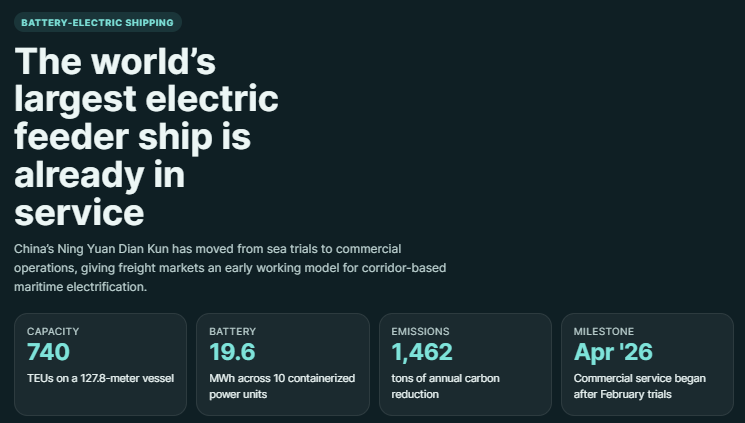
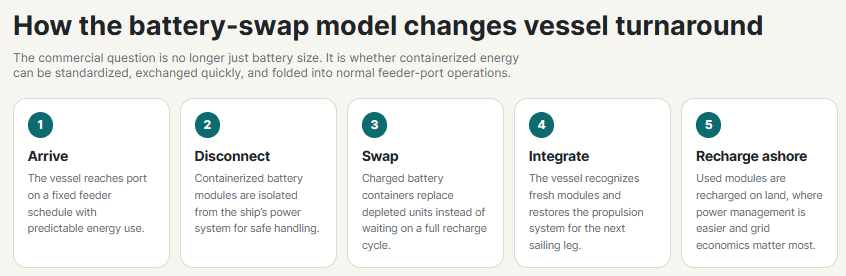
The battery packs are the core engineering innovation. Rather than relying solely on conventional charging, the vessel uses containerized battery modules that can be recharged via shore power or swapped in port. For regional services, this shifts the focus from range to the speed of energy system turnaround.
“From the initial project approval to the final delivery, the vessel showcased the full life-cycle development of zero carbon ships, characterized by pure electric propulsion, autonomous navigation and high operational efficiency.” — Ma Hongmeng, Shanghai Merchant Ship Design and Research Institute, quoted by China Daily
Commercial Case For Feeder Routes.
It would be a mistake to view this as a challenge to long-haul ocean shipping. Instead, this development directly tests the economics of battery-electric vessels in feeder networks, where routes are shorter, port calls are predictable, and emissions pressures are increasing. These conditions offer the best opportunity for electrification to move from pilot projects to broader adoption.
The Maritime Executive notes that the vessel was built for Ningbo Ocean Shipping’s feeder service into Ningbo-Zhoushan. This is significant because feeder services are operationally repetitive, providing the consistency needed to evaluate whether new propulsion models are viable investments.
Why Feeder Economics Makes Sense
Shorter voyages make battery sizing more practical and reduce the penalty of current energy-density limits.
Frequent port calls create more opportunities for shore charging, battery swapping, and planned energy management.
Regional routes make it easier to concentrate infrastructure spending at a limited number of terminals.
Customers and regulators are more likely to reward visible emissions cuts in dense coastal corridors.
Broader research supports this trend. A Berkeley Lab summary of a Nature Energy study found that excluding only 1% of the longest trips made electrification much more feasible, with charging demand concentrated at a small number of ports. For freight markets, this suggests that while full-fleet electrification remains distant, corridor-level electrification is becoming achievable.
“Declining battery costs coupled with increasing battery energy densities, cleaner grids, optimized vessel operations, and valuing the battery’s second life create a unique electrification opportunity in domestic shipping.” — Won Young Park, Berkeley Lab, quoted by Berkeley Lab
The operating model is the breakthrough
While public coverage has emphasized the ship’s size, investors should focus on its architecture. Battery-electric shipping will scale not through larger batteries, but by standardizing energy assets, reducing dwell time, and establishing repeatable port routines for charging and swapping.
This makes the Ning Yuan Dian Kun particularly noteworthy. The ship can use high-voltage shore charging or rapid battery replacement and incorporates autonomous navigation functions, including route planning and collision avoidance, according to The Maritime Executive. This is not only a propulsion advancement, but also a systems integration milestone.
What executives should be watching now
Port infrastructure: which terminals can support high-voltage charging or fast battery exchange without disrupting berth productivity?
Asset utilization: how much time does swapping save versus plug-in charging under live operating conditions?
Energy procurement: whether lower and more stable electricity costs can offset upfront capex and battery replacement risk.
Regulatory upside: how operators monetize lower emissions exposure as fuel standards tighten.
Fleet design: whether ships are built around route needs, not just around a decarbonization headline.
There is a labor and operating story here too
One of the most revealing quotes from the launch coverage came from the vessel’s captain. In China Daily, Captain Wang Ting said the most noticeable difference versus a conventional vessel is the lack of engine noise, creating a more relaxed working environment and helping crew concentrate better on operations.
This should not be dismissed as a minor benefit. In freight, labor conditions, training requirements, and onboard ergonomics directly impact reliability. Wang also noted that electric propulsion changes operational discipline: crews must actively manage energy use, monitor power consumption, and plan speed more strategically. This introduces new skill requirements for operators and fleet managers.
“Compared with traditional fuel-powered vessels, the most noticeable change in a fully electric seagoing ship is the lack of noise… voyages nowadays are almost silent.” — Captain Wang Ting, quoted by China Daily
What this means for investors
This does not suggest that battery-electric ships will soon transform intercontinental liner networks. Instead, it presents a more focused and investable thesis: battery-electric feeder shipping may be reaching commercial viability on selected regional corridors sooner than many market participants anticipated.
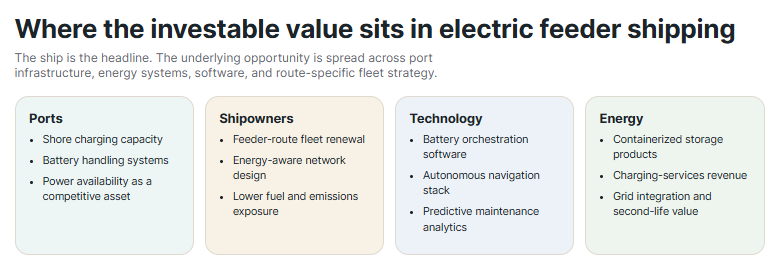
That opens several lanes of opportunity:
Shipowners: route-specific fleet renewal decisions become more data driven.
Ports: power, charging, and swap infrastructure become strategic capacity assets.
Battery and energy providers: containerized maritime storage becomes a product category, not just a custom engineering job.
Software platforms: energy-aware voyage planning, charging orchestration, and cost modeling move closer to core operations.
This is also why companies that can model these tradeoffs early may gain a competitive advantage. As electrification progresses from concept to corridor, tools like FreightFA become increasingly relevant, enabling decision makers to evaluate cost curves, routing tradeoffs, and the potential for green assets to outperform legacy assumptions.
The key insight
The freight market should view this launch as a template rather than an ambitious outlier. The vessel does not demonstrate that every ship can transition to electric propulsion, but it does show that, in the right operating environment, the combination of battery-electric propulsion, port-side energy strategy, and short-sea network design may already be sufficient to drive progress.
That is usually how real transitions begin in freight: not with a full industry flip, but with a narrow use case that works, then scales.
To benchmark your freight cost exposure against companies like Dollar Tree, FreightFA.com offers AI-powered freight cost estimates. This enables data-driven decision-making for your next contract negotiation.


