

Editor’s note (March 30, 2026): After publication, Norfolk Southern shared additional information about its notifications to first responders in Blair County.
Local reporting on the March 7 Horseshoe Curve derailment quoted Blair County 911 officials saying they “were not directly notified by the railroad” and instead learned of the incident through their own sources.
Norfolk Southern says its Network Operations Center sent a RapidSOS alert to Blair County 911 within minutes of the derailment, but that dispatchers did not realize the alert originated from NS due to the way the system displays. The text below has been updated to reflect that clarification.
The Victory Lap
On January 27, 2026, Norfolk Southern released a safety report highlighting a 31% reduction in FRA-reportable train accident rates for 2025, marking its best performance in over a decade. Injury rates also declined by 15% year over year. The Association of American Railroads confirmed these results, naming 2025 the safest year on record for the rail industry.
Two days later, Norfolk Southern announced Q4 2025 earnings: revenue totaled $3.0 billion, a 2% decrease year over year. The GAAP operating ratio was 68.5%, with an adjusted operating ratio of 65.3%, reflecting a 220 basis point improvement. Full-year revenue reached $12.2 billion.
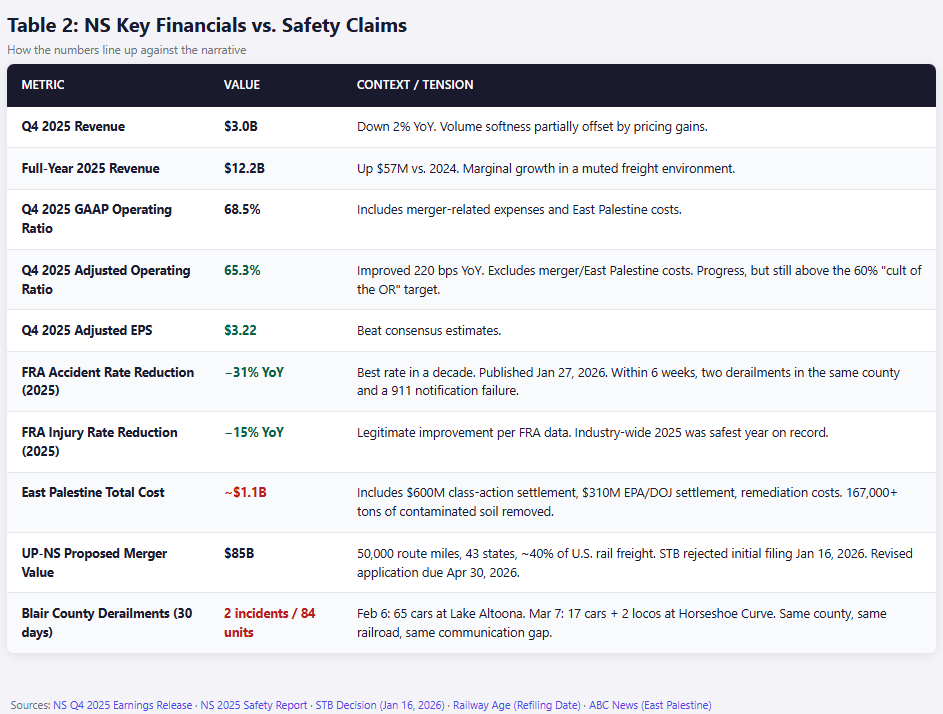
The company positioned itself as a safer railroad with improving financials, prepared for its next phase: an $85 billion merger with Union Pacific. This merger would create the first transcontinental U.S. railroad, spanning 50,000 route miles across 43 states and handling approximately 40% of the nation’s rail freight.
However, two incidents occurred in Blair County shortly thereafter.
Two Derailments. One County. Thirty Days.
On February 2, two derailments occurred in one county within thirty days. A Norfolk Southern train derailed near Lake Altoona in Logan Township, Blair County, Pennsylvania. Sixty-five railcars left the tracks, but there were no hazardous material spills or injuries, and all cars remained upright. The local fire department assessed the scene and determined no further action was required. Norfolk Southern classified the incident as a recovery operation and proceeded accordingly.
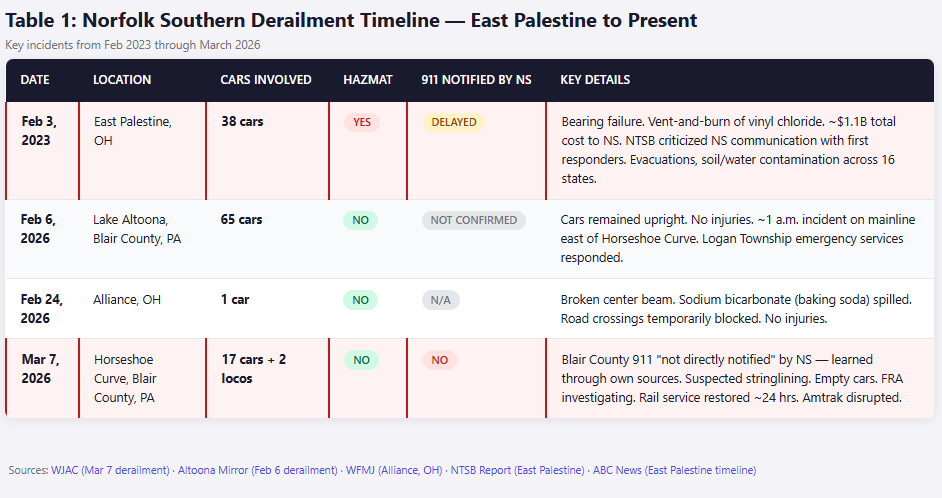
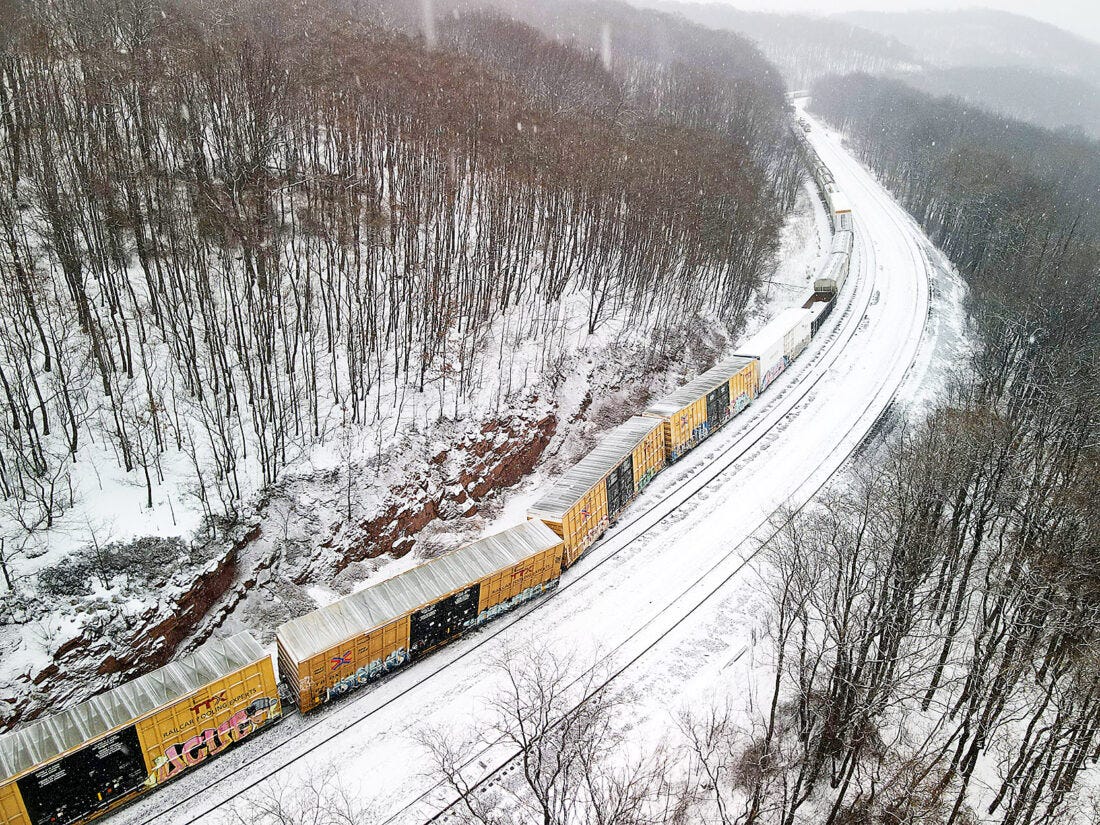
Thirty days later, on March 7 just after midnight, a second Norfolk Southern train derailed less than five miles away, near the historic Horseshoe Curve. Seventeen empty railcars and two locomotives left the tracks. There were no injuries or hazardous material spills. The FRA promptly dispatched investigators, and rail service was restored within approximately 24 hours.
Veteran railroaders who reviewed the footage suspect stringlining as the cause. Stringlining occurs when empty cars at the front of a train are pulled off the inside rail of a sharp curve by heavier trailing loads and helper locomotives pushing from behind. Horseshoe Curve, a 170-year-old engineering landmark, has consistently challenged train handling and operational discipline.
Between these two Blair County incidents, on February 24, a Norfolk Southern train derailed in Alliance, Ohio. One car with a broken center beam spilled sodium bicarbonate across a road crossing. As reported by BizJournals Atlanta, this incident occurred while U.S. lawmakers were already reconsidering bipartisan rail safety legislation.
In total, three derailments occurred within 48 days, just six weeks after the safety report was published.
The Physics and the Failure Mode
Horseshoe Curve warrants special attention, as its geography is central to the incident.
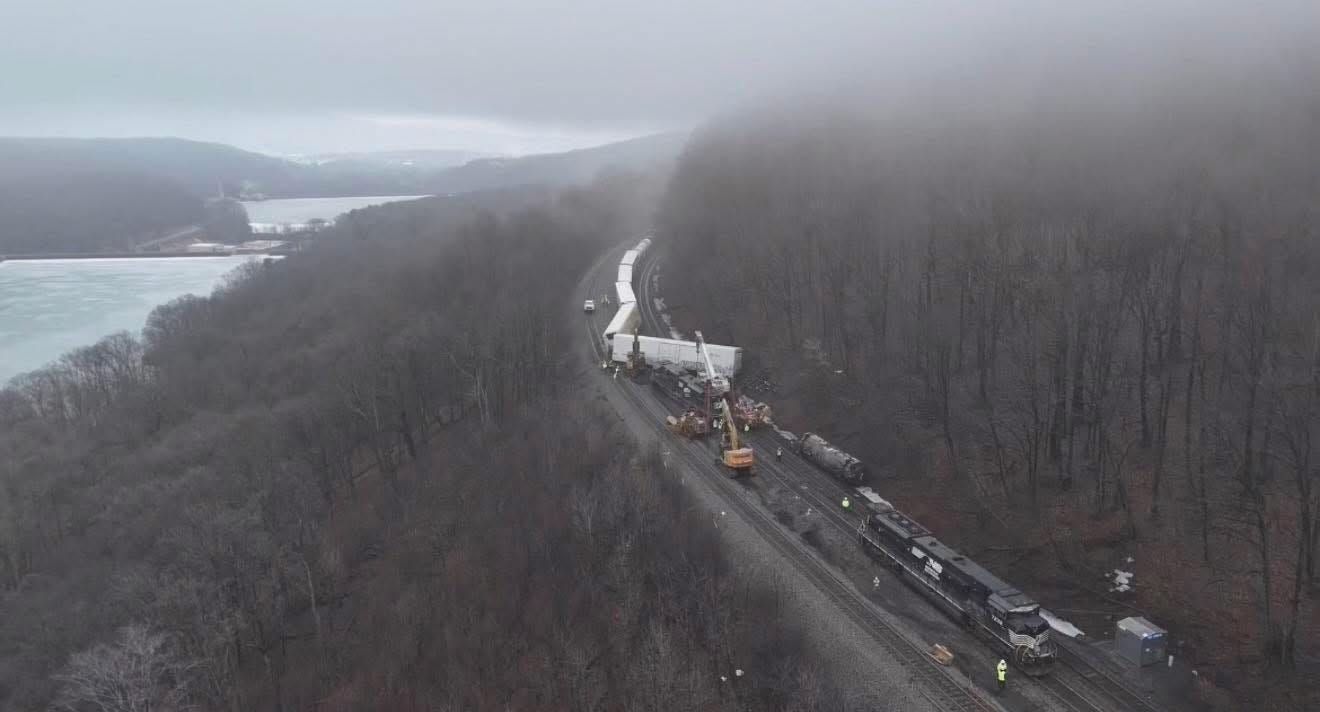
Constructed in 1854, the curve bends 220 degrees around the side of a mountain west of Altoona. It is one of the most renowned and demanding engineering landmarks in American railroading. Train crews operating on the Allegheny grade face significant challenges, including heavy loads, steep gradients, and a curve that magnifies any errors in train handling.
Stringlining, the suspected cause of the March 7 derailment, occurs when buff and draft forces exceed the rail’s capacity. This typically happens when empty cars are positioned at the front of a train and heavier loads or helper locomotives push from behind through a tight curve. The pushing force attempts to straighten the train, causing the lighter empty cars to be pulled off the inside rail. This is a well-known physics issue in railroading, and mitigation involves proper train makeup, speed management through curves, and coordinated power distribution between lead and helper units.
Veteran railroaders who reviewed footage of the March 7 derailment informed WJAC that the wreckage pattern was consistent with stringlining. The fact that all 17 derailed cars were empty supports this assessment. The FRA investigation is ongoing, and Norfolk Southern has not publicly commented on the cause.
The key operational question is: given that this segment is among the most demanding in the network and a major derailment occurred nearby just a month earlier, what changes were made to operating protocols? Additional scrutiny regarding train makeup, speed restrictions, and crew briefings is warranted. These are the questions the FRA will address, and the STB should consider during the merger review.
The 911 Problem
This detail shifts the focus from safety to credibility.
After the March 7 Horseshoe Curve derailment, the Blair County 911 Center told WJAC it “was not directly notified by the railroad about the derailment and instead learned of the incident through its own sources.” Norfolk Southern, however, says its Network Operations Center pushed a RapidSOS alert to Blair County 911 within minutes of the incident. The county later acknowledged that the alert came through, but was not recognized at the time as originating from NS because RapidSOS notifications do not carry prominent Norfolk Southern branding. In other words, there was a digital notification path, but it failed the basic test of being clearly understood as a railroad-initiated alert by the local 911 center.
Nineteen pieces of equipment, including two locomotives, derailed overnight on one of the busiest freight corridors in the eastern United States, yet the county’s emergency dispatch was not directly notified and learned of the incident through informal channels.
This is not a minor procedural issue. It reflects the same communication breakdown seen in East Palestine. On February 3, 2023, when 38 Norfolk Southern cars derailed in East Palestine, Ohio, the NTSB found that the company’s information sharing with first responders was inadequate. This contributed to the vent-and-burn decision that released vinyl chloride and contaminated soil and water across 16 states. The incident cost Norfolk Southern approximately $1.1 billion, including a $600 million class-action settlement and a $310 million EPA/DOJ settlement.
NS’s own 2025 safety report explicitly touted that it had “fulfilled every new safety recommendation issued by the NTSB” related to East Palestine, including “improving how we share information with first responders.”
Six weeks later, Blair County 911 again learned critical details about a derailment through informal channels, even though an NS RapidSOS alert had been sent. The technical notification was in place, but the communication still broke down at the human interface — exactly the kind of failure the East Palestine recommendations were meant to fix.
In summary, while the safety report stated that the communication problem was resolved, Blair County’s experience indicates otherwise.
Opponents of the merger now have additional evidence to support their position.
The UP-NS merger is already the most opposed rail consolidation in modern history. The STB unanimously rejected the initial filing on January 16 for incompleteness. A revised application is due April 30, 2026.
The list of opponents includes many major organizations in American commerce:
The American Farm Bureau Federation formally voted to oppose the merger at its annual convention, warning of higher costs and fewer options for agricultural shippers.
The American Chemistry Council, representing 190+ member companies, called it “an unnecessary, unwanted, and potentially crippling merger that would create a coast-to-coast rail monopoly”.
A coalition of 64 trade associations representing over 600,000 combined members warned that the deal would “put control of more than 40% of rail traffic in the hands of a single railroad”.
Nine state attorneys general — from Tennessee to Montana — called the merger a threat to national security.
47 Republican House members urged careful scrutiny of “transactions that could concentrate market power”.
All Class I competitors have publicly opposed the deal. CPKC CEO Keith Creel stated that further consolidation “is not in best interest of the industry, the shippers, or the U.S. economy” and described the combined entity’s handling of approximately 40% of U.S. freight rail traffic as an “unprecedented risk.” BNSF’s Tom Williams noted that “integration difficulties have historically caused widespread effects across the national network” and encouraged shippers to express their concerns.
Former STB Chairman Martin Oberman, never one to mince words, has repeatedly warned that railroads operate as “monopolies — or at best, duopolies — for a major portion of their customers”. If you already have monopolistic dynamics with four Class I carriers, three is not an improvement.
Blair County did not create the opposition, but it provided opponents with a new and compelling example.
The 1996 UP-SP merger provides the historical parallel. Union Pacific’s integration of Southern Pacific triggered a months-long network meltdown that paralyzed rail traffic across the western United States. Average train speeds plummeted. Tens of thousands of cars sat stranded on sidings for weeks. UP itself lost over $1 billion, and congressional inquiries estimated **$4 billion** in broader economic damage. Safety was a secondary concern at the time. In 2026 — post-East Palestine, mid-congressional debate on rail safety legislation — it’s the primary concern. The Brotherhood of Maintenance of Way Employes Division put it bluntly: the proposed combined railroad, spanning 43 states and 50,000 miles, “would be a de facto monopoly”.
Key Point: The safety report and the derailments are interconnected.
Most coverage presents the safety report and the derailments as separate issues. However, they are connected, and this connection is more significant than any individual incident.
The safety data was a merger argument. NS didn’t publish the January 27 report for investors alone. It was positioned as evidence for the STB filing: We’ve changed. We’re improving. Trust us with a bigger network. The 31% reduction statistic was designed to neutralize the East Palestine narrative. Two derailments in one county don’t just undermine the data — they undermine the premise.
The notification is the central issue. While the fact that empty cars remained upright may be attributed to chance, the Blair County experience suggests something different: although the paperwork says the communication problem is fixed and the technology is deployed, the people who actually answer 911 calls still told reporters they never heard directly from the railroad. The notification box may have been checked in NS’s Network Operations Center, but the message did not land where it mattered. For regulators considering approval of a 50,000-mile network, the key question becomes whether Norfolk Southern can be trusted to self-report incidents.
The timing of these incidents is highly unfavorable for the revised filing. With the April 30 refiling deadline approaching, Norfolk Southern and Union Pacific are currently preparing their revised STB application. Every opponent now has a clear argument:
Statistics vs. Anecdotes
Norfolk Southern’s primary defense is that three derailments do not negate a year of overall safety improvement. A 31% reduction in accident rate is a significant, FRA-verified achievement. Derailments are statistically inevitable on networks operating thousands of trains weekly, and no carrier operates without incidents.
That’s fair. And it’s also the kind of argument that dies on contact with a congressional hearing. After East Palestine, Norfolk Southern doesn’t get the benefit of statistical context anymore. Rightly or wrongly, the company is in a “zero tolerance” perceptual environment. Every derailment is measured against the mushroom cloud.
And the counterargument isn’t wrong in isolation. Aggregate safety improvement is real, and it would be intellectually dishonest to pretend three incidents erase a year of progress. But perception and regulation don’t operate in isolation. They operate in narrative. And NS is the one who chose to make safety the centerpiece of its public narrative — in the report, in earnings commentary, in the merger positioning. When you build the story, you own the story. Including the parts you didn’t write.
What’s The Bottom Line?
Norfolk Southern built a careful narrative for the merger: improving safety, disciplined financials, ready to scale. Blair County cracked that narrative in the one place NS can least afford it — trust. Not the numbers on the FRA report, but the basic question of whether the railroad picks up the phone when something goes wrong.
The $85 billion merger application will be resubmitted to the STB on April 30. FRA investigations into both Blair County incidents are ongoing. Congress is reconsidering bipartisan rail safety legislation. Opponents of the merger now have a compelling argument, comparable to those raised after the East Palestine incident.
If Norfolk Southern does not notify emergency services for a significant derailment, it raises concerns about entrusting the company with 40% of the nation’s freight.
Want these insights wired into your quoting process, not just your inbox? Get instant LTL, FTL, Rail, and intermodal rate intelligence at FreightFA. See what the platform can do!


