


Executives and investors in freight rarely receive clear early indicators, but Nvidia and Corning’s new U.S. manufacturing partnership is a notable exception. This initiative marks a major domestic industrial expansion with direct implications for freight volumes, regional lane development, capital deployment, and specialized logistics demand.
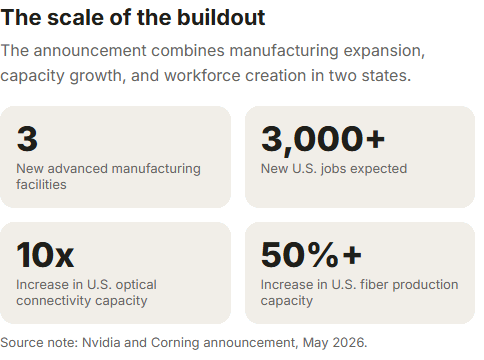
On May 6, Nvidia and Corning announced a multiyear commercial and technology partnership to expand U.S.-based production of optical connectivity systems for next-generation AI infrastructure. Corning will increase its U.S. optical connectivity manufacturing capacity tenfold, expand fiber production capacity by over 50%, build three advanced manufacturing facilities in North Carolina and Texas, and create more than 3,000 new American jobs. NVIDIA / CNBC
Listen on Apple & Spotify / Watch on YouTube
This announcement is significant as it aligns with three key trends currently reshaping freight markets:
Domestic manufacturing expansion tied to AI infrastructure
A transition from copper to optical interconnects inside data center systems
Supplier clustering in North Carolina and Texas around high-value, high-spec industrial production
For those in trucking, rail, intermodal, warehousing, industrial real estate, and logistics technology, the key takeaway is clear: the physical supply chain supporting AI has become a U.S. freight story.
Why this partnership has broader significance
The partnership supports hyperscale data center deployment, where optical connectivity enables large-scale data transfer between processors, servers, and racks. Nvidia stated that Corning’s expanded capacity will provide the optical connectivity required to deploy Nvidia-accelerated computing at scale. NVIDIA

Jensen Huang framed the move in unusually direct industrial terms: “AI is driving the largest infrastructure buildout of our time — and a once-in-a-generation opportunity to reinvigorate American manufacturing and supply chains.” NVIDIA / CNBC
Huang’s statement extends beyond chip design or server demand, explicitly addressing supply chains and manufacturing footprints. This is important for investors, as freight demand typically appears first through factory siting, supplier contracts, machinery movement, construction inputs, and increased regional production, rather than in headline earnings.
Key Technology Shift for Freight Leaders
The technical backdrop is the shift toward co-packaged optics, which industry reports say would allow Nvidia to replace thousands of copper cables in its rack-scale systems with glass fiber. CNBC reported that Nvidia’s Vera Rubin rack-scale systems currently use about 5,000 copper cables, and that Corning’s glass fibers can transmit data faster while using 5 to 20 times less power than copper cables. CNBC
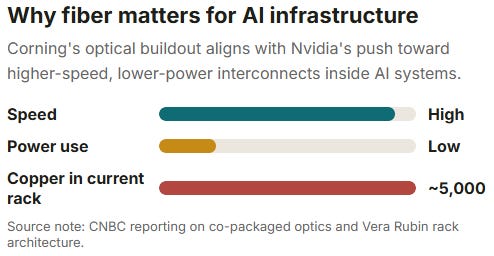
For logistics operators, this marks a shift from a semiconductor focus to a freight planning challenge. As AI infrastructure moves from copper-based to fiber-based systems, both upstream and downstream freight profiles will change.
This shift does not necessarily increase shipment tonnage. Instead, it may result in higher-value freight, stricter handling requirements, faster replenishment cycles, more plant-to-campus lanes, and a greater proportion of shipments linked to critical infrastructure timelines.
Why North Carolina and Texas Matter
North Carolina and Texas were selected due to their established roles within broader domestic manufacturing and infrastructure networks.

North Carolina has become an increasingly important hub for fiber and optical manufacturing. Earlier this year, Meta agreed to pay Corning up to $6 billion through 2030 for fiber-optic cable for AI data centers, with manufacturing expansion tied to Corning’s North Carolina operations, including Hickory. Reuters / CNBC
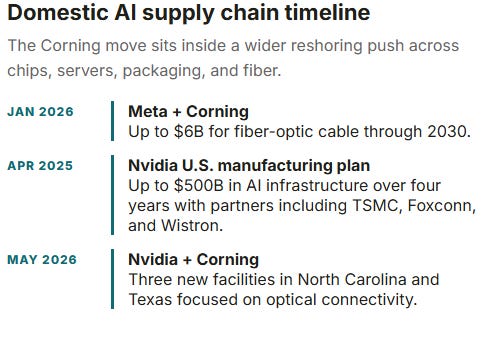
Texas is emerging as a centerpiece of Nvidia’s broader domestic production strategy. Reuters reported in April 2025 that Nvidia plans to produce up to $500 billion worth of AI infrastructure in the U.S. over four years, including Blackwell chip production in Arizona and supercomputer manufacturing plants in Texas with Foxconn and Wistron. Reuters
Together, these developments reveal a clear pattern: North Carolina is strengthening the optical manufacturing segment, while Texas is focusing on compute and systems. Freight networks will connect both regions.
The Freight and Logistics Implications
At this stage, these details are especially relevant for executives and investors focused on logistics demand rather than technology headlines.
1) New inbound industrial flows
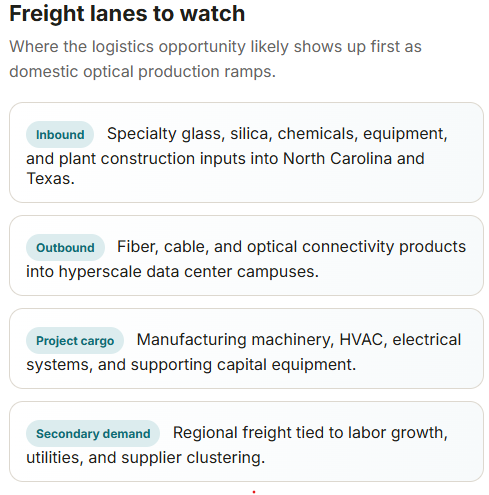
The three new advanced manufacturing facilities will require construction materials, capital equipment, precision machinery, electrical systems, HVAC systems, specialty chemicals, silica-related inputs, and supporting components. NVIDIA
This will generate near-term freight activity before full production begins. Initial revenue often comes from transporting materials needed to build the plant, rather than from its eventual output.
2) New outbound high-value lanes
Once production ramps up, output will likely move into hyperscale data center projects and adjacent manufacturing nodes. These shipments may not resemble commodity freight, as they could require tighter packaging standards, higher security, greater appointment sensitivity, and less tolerance for service failure.
This environment enables carriers, brokers, and 3PLs with strong cost discipline and specialized handling capabilities to differentiate themselves.
3) Corridor concentration matters
When multiple AI-related suppliers and manufacturers expand within the same states, regional freight density increases. This greater density enhances asset utilization, reload opportunities, warehouse demand, and supports dedicated operations.
Investors should look beyond facility counts and monitor whether supplier ecosystems are clustering around these locations.
4) More project freight, more irregular demand
AI infrastructure buildouts generate not only steady-state replenishment freight but also waves of demand, including site preparation, plant construction, machinery installation, early production, and recurring output. As a result, irregular but high-value freight demand is likely to emerge before lane structures are fully established.
For many operators, this shift is less about traditional bid cycles and more about leveraging market intelligence.
The Capital Markets Angle
Another important signal is the level of financial commitment Nvidia is making to this partnership. CNBC reported that the arrangement allows Nvidia to invest up to $3.2 billion in Corning, including warrants tied to Corning shares and an additional $500 million pre-funded warrant. CNBC
For investors, this indicates a strategic supply chain partnership rather than a standard procurement agreement. When a customer secures capacity at this scale, it typically signals that ensuring production is as important as negotiating price.
In freight terms, strategic supply chain shaping often leads to earlier regional infrastructure investment, more durable contract volumes, and greater urgency regarding execution risk.
What To Watch Next
This story is still in its early stages, so the most reliable indicators are operational rather than rhetorical.
Watch for:
Exact facility locations and construction timelines in North Carolina and Texas
New supplier announcements around glass, cable, connectors, packaging, and testing
Data center campus expansion that lines up with these manufacturing corridors
Signs that freight demand moves from project-based to recurring production-based flows
Regional warehousing and transload capacity tightening near AI manufacturing nodes
For freight operators, accurate pricing is as important as identifying the right lanes. Specialized industrial freight penalizes inaccurate assumptions, making robust lane-level cost intelligence increasingly important as AI-related manufacturing expands beyond chips into the broader supply chain.
Why this matters for FreightTech readers
Much of the AI coverage still treats infrastructure as abstract, but it is not. It is glass, fiber, racks, power systems, factories, and concrete. This is why the Nvidia-Corning partnership warrants attention from freight executives and investors. It provides clearer insight into where the AI supply chain is becoming tangible within the United States.
The next phase of AI will involve not only software development but also the physical movement, installation, storage, quoting, insurance, and management of assets across domestic freight networks.
This is exactly the type of shift that warrants early attention.
Resources & Links:
Freight Flow Advisor — Your freight intelligence platform
Corning Official Website — Innovator in optical fiber technology
NVIDIA Official Website — Leader in AI hardware and infrastructure


