

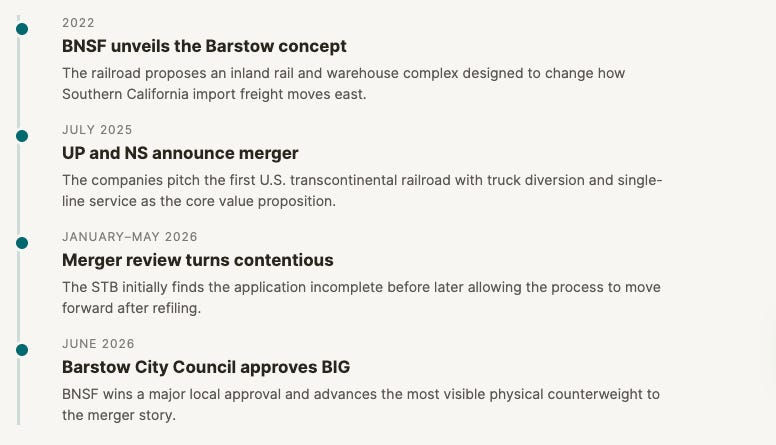
The freight Rail industry is in the middle of a seismic shift. On July 28, 2025, Union Pacific and Norfolk Southern announced a proposed merger valued at approximately $85 billion that would create the first coast-to-coast freight railroad in U.S. history — branded The Union Pacific Transcontinental Railroad. If approved by the Surface Transportation Board (STB), the combined entity would operate a 52,215-mile network and hold over 40% market share in most commodity categories. Based on 2024 financial results, a transcontinental UP would have 56% more revenue than the No. 2 railroad, BNSF.
This is not a distant threat; it is existential. BNSF is responding proactively.

On June 17, 2026, less than a year after the merger announcement, the Barstow City Council unanimously approved BNSF’s Barstow International Gateway (BIG), a $4 billion integrated rail facility on Barstow’s west side. The timing underscores its strategic importance. BIG represents BNSF’s most significant strategic initiative in decades and is central to the evolving competitive landscape of American freight.
BIG by the Numbers: 4,500 Acres, 206 Miles of Track, and a 2–3 Day Time Advantage
The Barstow International Gateway introduces a new model for the rail industry. Key differentiators include:
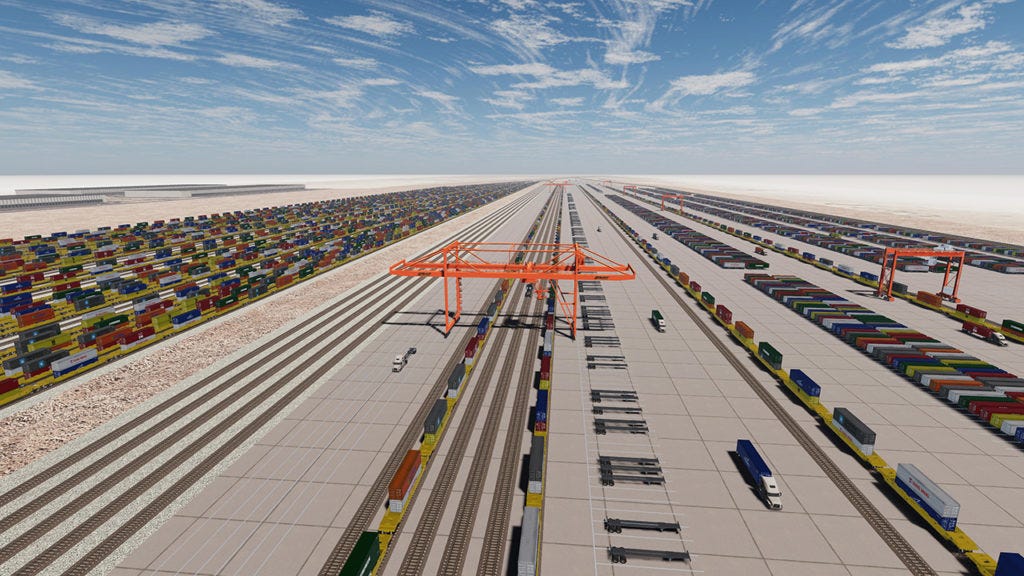
Scale: 4,500 acres, 206 miles of track, 52 miles of fencing, 35 bridges and culverts, and capacity for 60 trains simultaneously.
Integration: A single campus that combines a rail yard, intermodal facility, and on-site transload warehouses, eliminating multiple handoffs that currently slow freight movement.
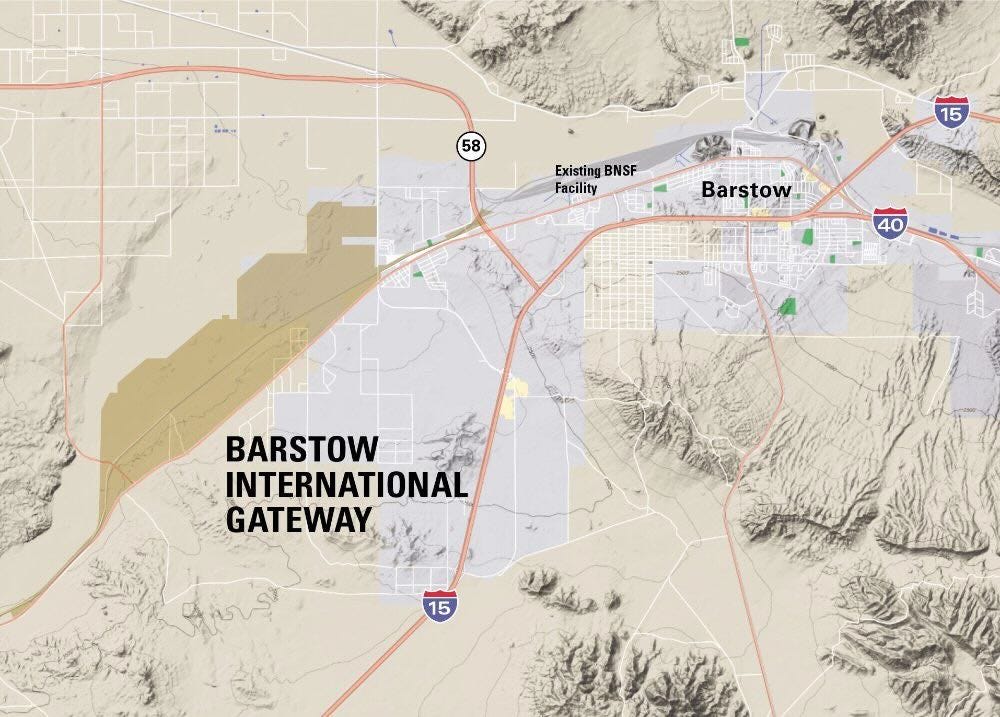
Location: Approximately 100 to 130 miles from the Ports of Los Angeles and Long Beach, directly on BNSF’s Southern Transcon, the nation’s busiest rail corridor for imported goods.
Technology: Zero-emission cargo-handling equipment, battery-electric yard trucks, and solar power installed on warehouse rooftops.
Speed: According to BNSF CEO Katie Farmer, BIG can reduce the typical intermodal transload process by two to three days.
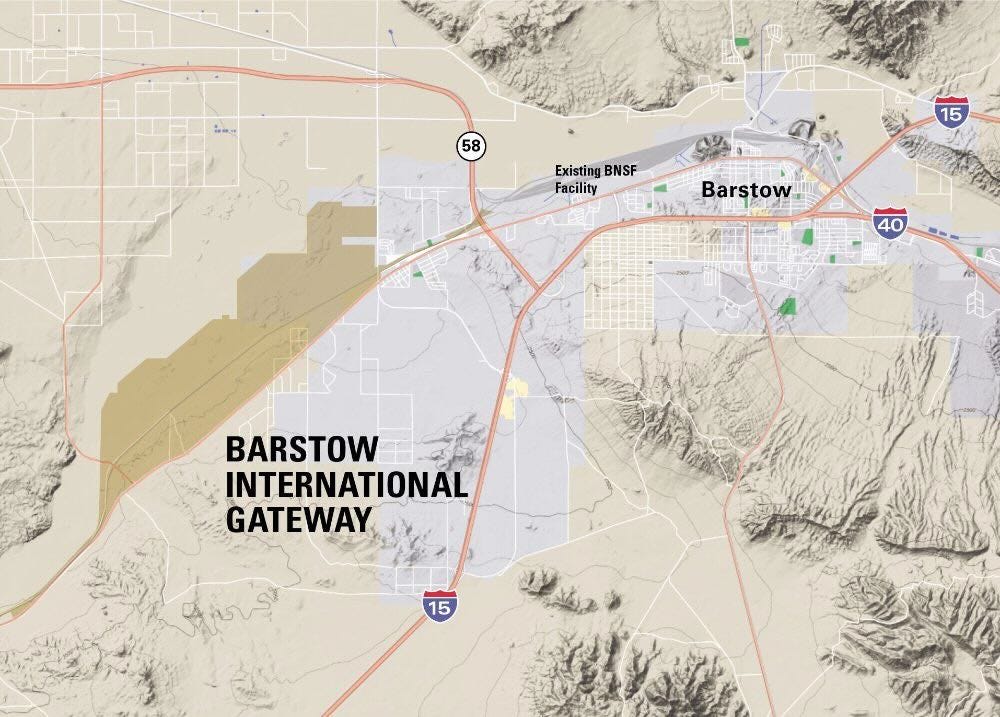
Currently, most international cargo arriving at the Ports of Los Angeles and Long Beach is transported by truck to warehouses throughout the Inland Empire, resulting in congestion and higher costs. BIG changes this model by moving containers by rail through the Alameda Corridor directly from the port to Barstow, where they are transloaded from 40-foot ocean containers into domestic 53-foot containers and assembled into outbound trains for eastbound distribution across BNSF’s national network.
The result is fewer trucks on Southern California highways, faster freight movement, and a more competitive BNSF.
When fully completed, BIG will be the largest intermodal facility in North America, twice the size of any existing hub.
5 Million Intermodal Shipments a Year and a Seamless Port-to-Interior Pipeline
Locking Up the West Coast Gateway
BNSF moves more than 5 million intermodal shipments per year, more than any other North American railroad. Its Southern Transcon route from the Los Angeles and Long Beach port complex east is a critical competitive corridor. If UP and NS merge, the combined railroad will target both eastern and western shippers with single-line service. For BNSF, maintaining its dominance on the Pacific gateway is essential.

BIG strengthens BNSF’s position at the gateway. By establishing a fully integrated inland port 130 miles from the docks, BNSF can offer shippers a seamless, fast, and cost-effective port-to-interior pipeline, unmatched by any other railroad on the West Coast.
The Port of Long Beach is investing over $2 billion of its planned $3.2 billion capital expenditure over the next decade in rail-related projects, aiming to reduce ship-to-train dwell time from nearly four days to under 24 hours. BIG is well positioned to benefit from this investment.
BIG’s Block-Swap Yard Cuts Dwell Time While UP-NS Pitches 24–48 Hour Transit Savings
A transcontinental UP-NS would eliminate interchange handoffs on key lanes, saving shippers 24 to 48 hours in transit time on certain routes. The primary advantage of the merger is single-line service without interchanges.
BNSF’s strategy is to build infrastructure that addresses this gap independently. BIG’s block-swap yard, on-site warehousing, and integrated TMS systems are designed to significantly reduce dwell time and eliminate inefficient drayage steps in the Los Angeles Basin. In the six weeks following the launch of BNSF’s new CSX intermodal partnership, CSX intermodal volume increased by 8% while Norfolk Southern’s declined by 6.8%. BNSF recognizes that service speed, not just price, is critical to winning freight.
BIG Targets the Same 2.1 Million Truckloads UP-NS Is Promising Regulators
The UP-NS merger’s central promise to regulators is to convert 2.1 million truckloads annually to intermodal, thereby reducing CO2 emissions and strengthening the case for approval. BNSF sees the same prize — and BIG is its vehicle to capture it independently. inteklogistics
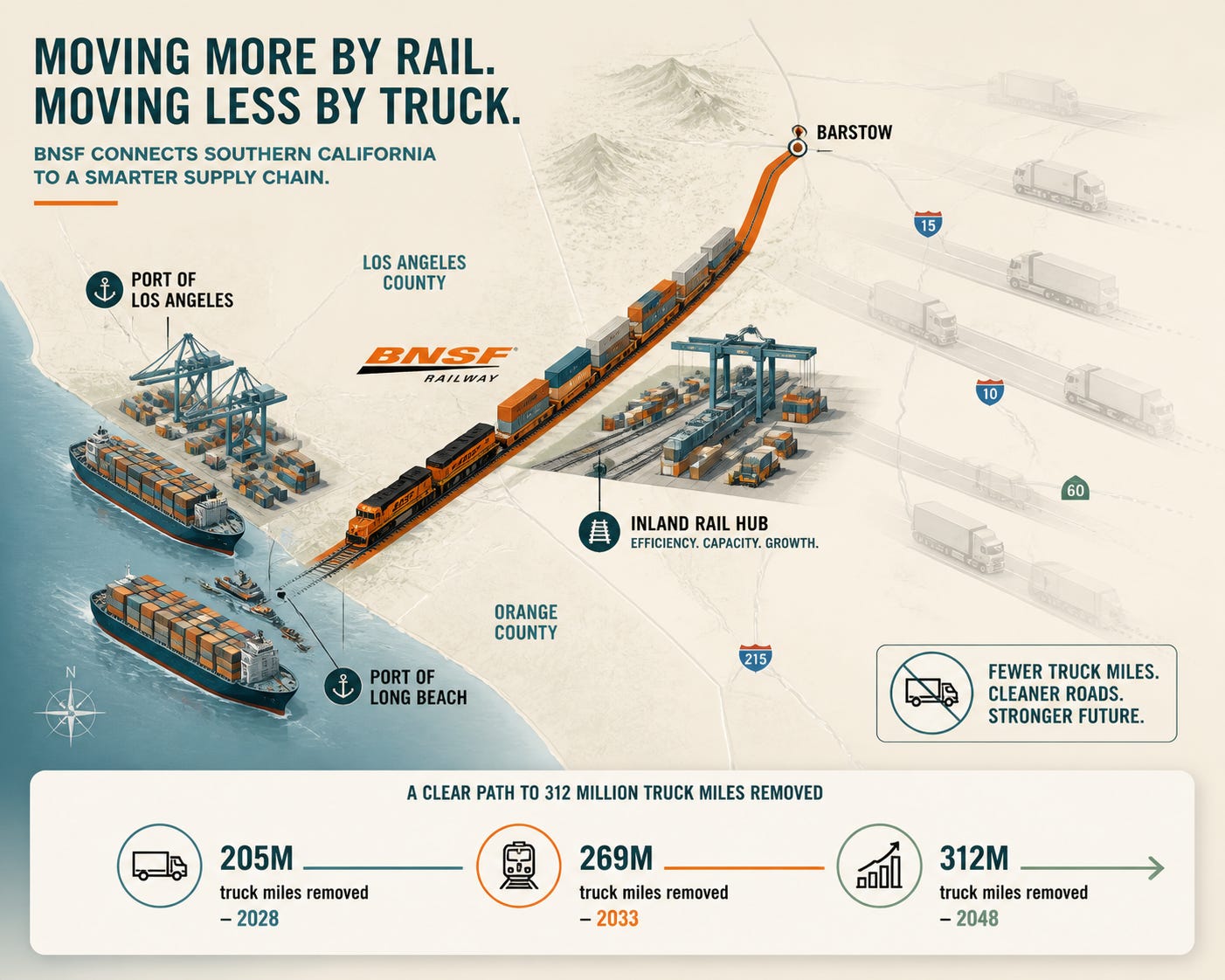
BIG is projected to eliminate approximately 205 million truck miles traveled (TMT) in 2028, increasing to 269 million TMT in 2033 and 312 million TMT in 2048. This provides both environmental benefits and increased market share. Each truckload converted to a BNSF intermodal move represents a customer not reliant on the UP-NS transcontinental network.
SB 149 Certification Gives BNSF a Barrier No Rival Can Quickly Replicate
Here’s a strategic dimension that rarely gets discussed: California’s infrastructure permitting process is notoriously difficult. BIG just became the first transportation project to receive certification under California’s landmark SB 149 legislation, which accelerates critical infrastructure projects — and only the 10th local or regional transportation project statewide to earn the designation. bnsf
This creates a significant competitive barrier. No rival railroad can replicate a 4,500-acre facility in the Southern California freight corridor without facing years of environmental review, local opposition, and state regulatory challenges. BNSF’s early start, first announced in 2022 and approved in 2026, establishes a barrier to entry that cannot be quickly overcome.
Three Risks That Could Change BIG’s Strategic Value
It is important to acknowledge the associated risks. While BIG is a significant investment, it is not without vulnerabilities.
Construction Timeline Risk
The project received city approval in June 2026, with construction targeting a late 2026 start. But environmental review delays, permit challenges, and California Air Resources Board (CARB) regulations have already threatened the project. In 2023, CARB’s proposed in-use locomotive rule would have required BNSF to contribute up to $800 million annually in zero-emission compliance costs — a requirement that nearly killed the project before more than 30,000 public comments pushed regulators to withdraw the rule. Those regulatory landmines could resurface.
The final Environmental Impact Report indicated that criteria air pollutants could exceed regulatory thresholds in Barstow and potentially in Los Angeles, Orange County, and the Inland Empire if truck traffic reductions do not occur as planned. If BNSF does not meet its truck-elimination commitments, regulatory and legal challenges may delay or alter the project.
The UP-NS Merger Might Not Happen
The STB review process is extensive. The UP-NS merger application was rejected once in January 2026 as incomplete, refiled in April, deemed “mostly complete” in May, and a final decision is not expected until 2027 at the earliest, with a potential close in early 2027. If regulators ultimately block the merger — which a growing coalition, including the Teamsters, 72 members of Congress, and shippers representing over half of U.S. Rail volume, is demanding — BNSF may find itself having committed $4 billion to a facility that was partly justified as a competitive response to a threat that never materialized.
Nonetheless, BIG’s value proposition remains strong regardless of the merger outcome. Port congestion, truck conversion, and supply chain efficiency are ongoing trends that are independent of the merger.
Intermodal Container Diversion Risk
The UP-NS merger application projects that 303,000 intermodal containers will shift from other railroads to the merged entity. If even a fraction of that volume comes from BNSF’s existing intermodal flows on lanes where NS currently interchanges with BNSF, the revenue base that BIG is meant to grow could face early headwinds before the facility is even operational. inteklogistics
The BNSF-CSX Merger Question
Analysts and academics widely agree that a completed UP-NS merger would likely compel BNSF to consider a merger with CSX to remain competitive. If BNSF merges with CSX, BIG’s strategic role would shift as it becomes part of a larger network, altering BNSF’s independent identity and decision-making authority. BNSF CEO Katie Farmer has stated the railroad has “no interest” in a merger, though market and competitive pressures may influence future decisions.
$3.6 Billion in Capex and Active STB Opposition Signal a Full Competitive Mobilization
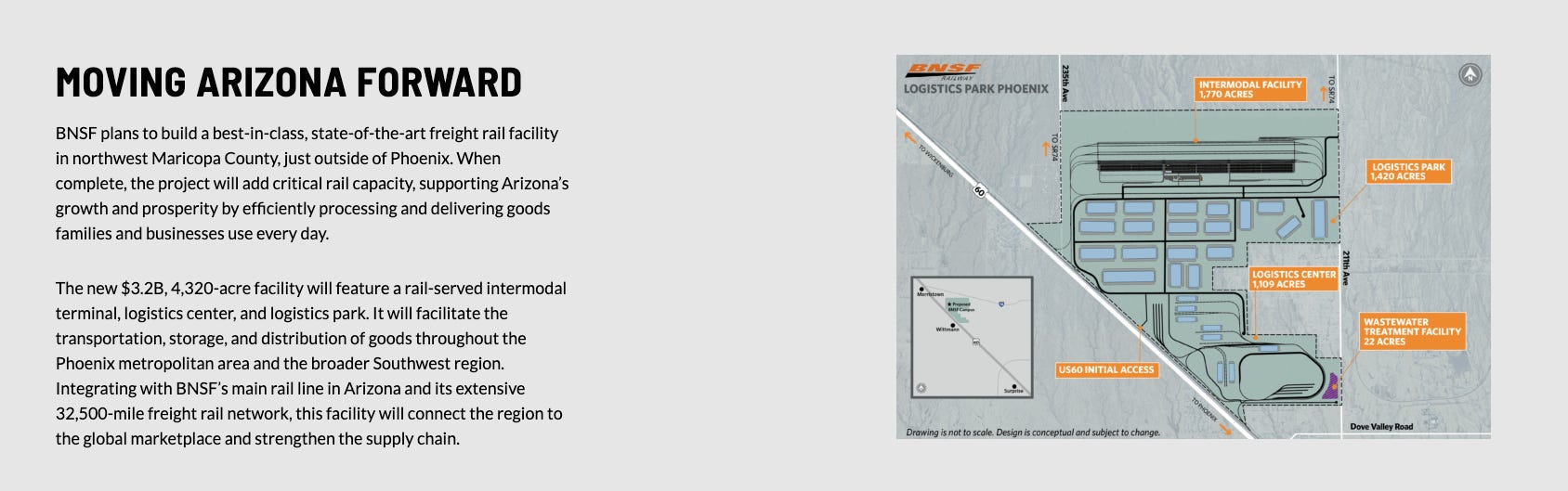
BIG is the headline, but it’s part of a broader competitive mobilization. In January 2026, BNSF announced a $3.6 billion capital investment plan for 202, with $2.8 billion devoted to maintenance and $358 million to expansion projects, including BIG and a new intermodal facility in the Phoenix area. This is a railroad investing aggressively at precisely the moment its biggest competitor is trying to become twice its size. bnsf
BNSF is also active on the regulatory front. The railroad maintains a dedicated website opposing the UP-NS merger (bnsf.com/merger) and participates in all relevant STB proceedings, state legislatures, and shipper conferences. CEO Katie Farmer contends that UP’s “Committed Gateway Pricing,” the merger’s proposed competition remedy, would benefit only 1% of customers, significantly less than the 20% estimated by CPKC’s CEO and less than proponents suggest.
BNSF also launched the Alameda Belt Line (ABL) in partnership with Union Pacific in 2025 — a joint venture that functions as a neutral third party to optimize freight mobility through the Alameda Corridor. By June 2025, BNSF’s average terminal dwell at the Southern California ports had reached three days — its best mark since December 2021. That operational improvement, combined with BIG’s long-term capacity, builds a service story that will be hard for any merged railroad to undercut on the West Coast.
BNSF Is Building Now — The Facility Will Process Freight Whether the Merger Happens or Not
BNSF is taking decisive action. The Barstow International Gateway is clear, capital-intensive evidence of this commitment. While Union Pacific and Norfolk Southern invest heavily in legal and regulatory processes with uncertain outcomes, BNSF is constructing a facility that will process freight regardless of the STB’s decision.
The 2024 State Rail Plan identified BIG as the first facility of its kind developed by a Class I railroad, emphasizing its potential to significantly reduce truck trips and improve statewide goods movement. Governor Gavin Newsom’s office expedited the project under SB 149, and the City of Barstow approved it unanimously. This alignment among federal, state, local, and private stakeholders is notable.
The risks are significant. A merged UP-NS would control over 40% of rail freight, with the pricing power and network reach to challenge BNSF on competitive routes. Regulatory delays could postpone BIG’s operational start beyond 2028. If BNSF pursues a merger with CSX, the competitive landscape would change substantially.
Currently, BNSF is actively working to maintain its dominant position on the most important freight gateway in the Western Hemisphere. BIG represents BNSF’s commitment to shaping the future of American freight through Barstow.
For shippers, investors, and supply chain strategists, the key question is not whether BNSF will compete, but whether BIG will become operational quickly enough to have a meaningful impact.
Track the Rail Moves That Will Reshape Your Network
The BIG approval, the UP-NS merger filing, and a shifting STB are all moving simultaneously. FreightFA tracks the intelligence behind rail consolidation, intermodal routing, and freight cost dynamics so shippers, operators, and investors can make decisions before the market moves.


